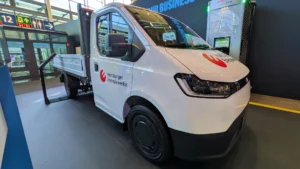

The Great Wall Steed is a proper workhorse of a vehicle. It’s a roughty-toughty four-wheel-drive pickup truck that has sold in Australia for a few years now, and we know they don’t give a fourex for any four by four unless it can shift a hundred slabs of tinnies across the outback without breaking down.
Don’t be misled by the Australian success though, as this machine hails the ninth largest car manufacturer in China, Great Wall Motors, which means it arrives in the UK with a bargain price and an uphill battle for acceptance.
Great Wall Steed: First Impressions
Great Wall has played it safe with the styling, producing a pickup truck that has some surprisingly rounded edges, almost reminiscent of a soft-roader. There are no chrome nudge bars, no cliff-face chrome grille, just a pair of chrome running boards and a set of massive side mirrors. It’s not a tough-looking truck, but perfectly pleasant to look at.

Great Wall Steed: What’s It Like Inside?
If you work on a farm, the inside is perfectly fine. There are hard, shiny plastics wherever you look, with clunky plastic buttons and knobs to press and twist. It will all come up clean and shiny with little more than a damp cloth, I’m sure.
However, if you’re trading in your Vauxhall Insignia in order to drive something just a little different, then you’ll find it’s a bit like stepping back into an old Cavalier.

Ergonomically it’s also showing the lack of a multi-billion development budget. Buttons to switch between two and four-wheel drive are mounted high up on the centre console, above the stereo, while there’s a button hidden to the right of the steering wheel that after an entire week I still have no idea what it does.
This mysterious button was also just above a part of the dashboard that simply didn’t fit the rest of the interior, leaving a sharp edge ready to snag a coat as you get in and out.
On the plus side, the interior has plenty of room in the front and rear. There is also an odd mix of equipment, from heated leather seats to Bluetooth hands-free kit, even on the entry-level model. Trade up to the SE spec tested here and you’ll also get a body-coloured hard-top, roof rails and much needed rear parking sensors.

Great Wall Steed: What’s It Like To Drive?
The Steed’s saving grace, beyond its price, is that it’s actually a rather refined vehicle to drive. The hard shudder that many pickups provide over bumps when empty is missing from the Great Wall thanks to independent suspension all around, leading to a pleasingly comfortable ride, especially at motorway speeds.
It will never rival a sports car for handling, but it turns well enough, pushing to understeer earlier than a hatchback driver might expect, but remaining easy to control and predictable.
The 2.0-litre turbo diesel engine puts out just 143hp, but that’s just enough for day-to-day driving despite weighing in at just over 1.8 tonnes. That does mean the economy suffers though, with an official combined figure of 34.0mpg.

Great Wall Steed: Is It Really Tough?
There’s a reason the Steed is selling well in the agricultural community, and that’s because it’ll cope with anything the farming landscape can throw at it. That might mean climbing the Eiger is out of bounds but, thanks to that clever suspension, muddy hills, river crossings and ploughed fields won’t present any issues to the Steed.
Great Wall Steed: Is It Safe?
Anti-lock brakes with emergency brake distribution are fitted, but beyond that, you’re on your own as far as electronic gadgetry goes. Should the worst happen, there are just two airbags, one for each front occupant.
The Steed hasn’t been tested by Euro NCAP, but the Australian’s ran its V240 twin through similar ANCAP tests where it scored two stars from five.

Great Wall Steed: What’s the Competition?
Priced at just over £19,000 including VAT, no other pickup truck gets close to the Steed on value. The Mitsubishi L200 and Isuzu D-Max are closest in concept perhaps, but both cost at least £5,000 more for a similar spec.
Great Wall Steed: Should I Buy One?
Despite its fine on-road manners and stunning value for money, it’s tough to recommend the Steed, especially as a new car. It will serve many people very well, but a one-year-old Toyota Hilux will serve them better.
- Farizon SV electric van to gain faster charging and four-wheel drive

- Geely Farizon admits European expansion will be ‘extremely challenging’

- Electric Van Man plugs market gap with UK’s first dedicated used electric van dealership
- Stellantis sets 2029 date for next-generation large van
- Ford puts Transit City to work with new chassis cab