
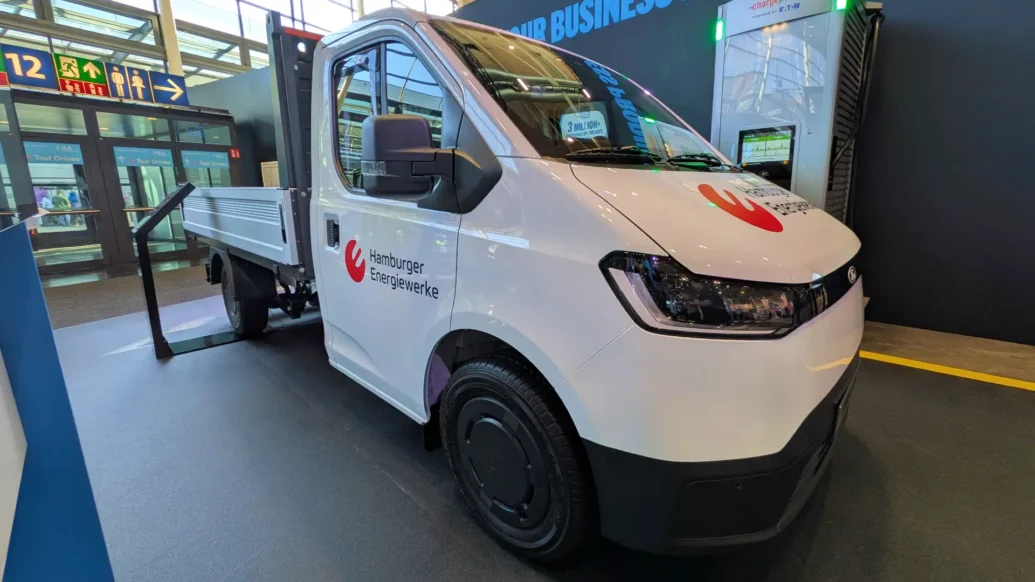
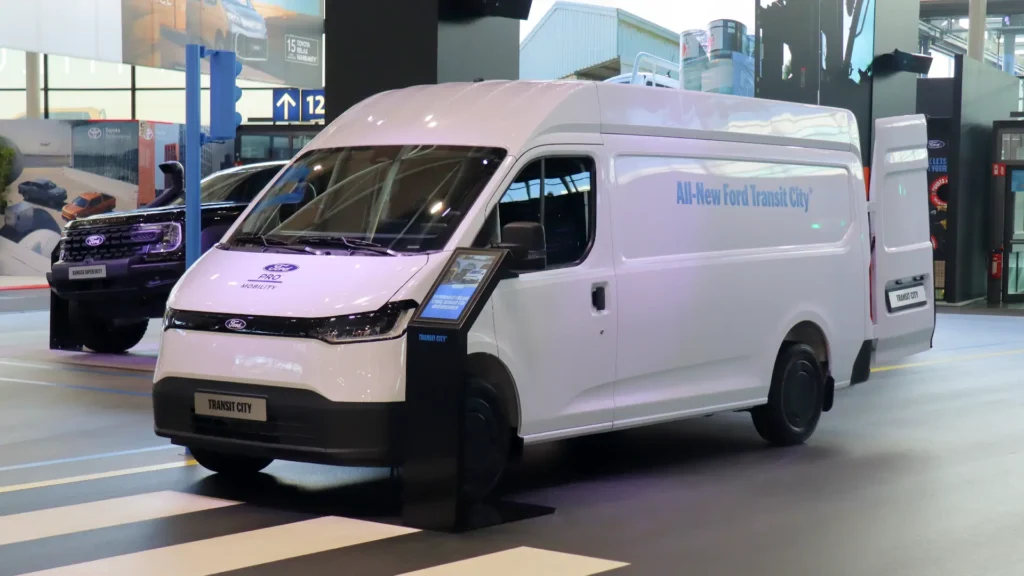
Ford has shown the chassis cab version of its new electric Transit City for the first time, alongside box van, dropside and refrigerated conversions at IAA Transportation in Hanover.
Orders have already opened for the regular Transit City panel van, with the chassis cab set to join the compact electric range next.
Ford says the Transit City has been developed as an affordable, city-focused model for businesses facing clean-air zones and other operating restrictions. Sitting alongside rather than replacing the larger Transit Custom, it also gives major fleets a comparatively modest way to increase the electric share of an otherwise conventional van operation.
The chassis cab is Ford Pro’s first dedicated electric model in the one-tonne compact chassis cab sector. Ford says it worked with European conversion companies and large fleet customers during its development, with box and dropside bodies available through its One-Stop Shop conversion programme.
Ford Transit City conversions
The box van conversion, developed with Italian bodybuilder Scattolini, provides 10.4m3 of load space and a maximum payload of 1,120kg.
Its load compartment measures 3,010mm long, 1,930mm wide and 1,800mm high. Twin rear doors open through 270 degrees, while a separate side door provides kerbside access.
Lightweight glass-reinforced plastic panels and aluminium crossmembers are intended to reduce the conversion’s impact on payload and driving range. A translucent roof also reduces the need for interior lighting during daylight hours.
The Scattolini dropside increases maximum payload to 1,300kg. Its load bed is 3,130mm long and 2,000mm wide, with aluminium side and tailboards mounted to a steel subframe.
Both will form part of Ford’s One-Stop Shop programme, allowing customers to order the completed conversion through a Transit Centre with a single invoice and a warranty matched to that of the base vehicle.
Electric Power Take Off system coming in 2027
A refrigerated box body developed with Lecapitaine demonstrates the Transit City’s forthcoming electric power take-off system.
Expected to be available during 2027, the ePTO can supply up to 3kW of DC power from the van’s traction battery, providing enough juice to power equipment including refrigeration units, tippers, tail lifts and high-pressure pumps.
However, the refrigerated model displayed at Hanover remains a near-production concept rather than a currently available conversion.
Ford Transit City range and charging
The Transit City uses a 56kWh lithium iron phosphate battery and a 110kW (150hp) electric motor. Ford quotes a maximum range of 158 miles under the standard WLTP test cycle, increasing to as much as 236 miles under the more favourable city cycle.
That headline urban figure should be treated cautiously, particularly for box-bodied and refrigerated versions. Ford has not yet published individual range figures for the converted models displayed at Hanover.
DC charging peaks at a relatively modest 87kW, allowing a 10–80% recharge in a little over 30 minutes — theoretically enough for another 165 urban miles. The equivalent charge using an 11kW AC connection takes approximately four and a half hours.
Running costs and pricing
Servicing costs are said to be around 40% lower than for an equivalent diesel van, with service intervals set at two years with no mileage limit.
The Transit City is expected to launch in the UK at £29,000 plus VAT for a SWB H1 panel van, rising to £31,500 for the larger LWB H2 van. The Chassis Cab model will be priced from £31,500 plus VAT.
Pricing for conversions and a detailed launch timetable remain unconfirmed.

- Farizon SV electric van to gain faster charging and four-wheel drive - 18 September 2026
- Geely Farizon admits European expansion will be ‘extremely challenging’ - 18 September 2026
- Electric Van Man plugs market gap with UK’s first dedicated used electric van dealership - 17 September 2026