
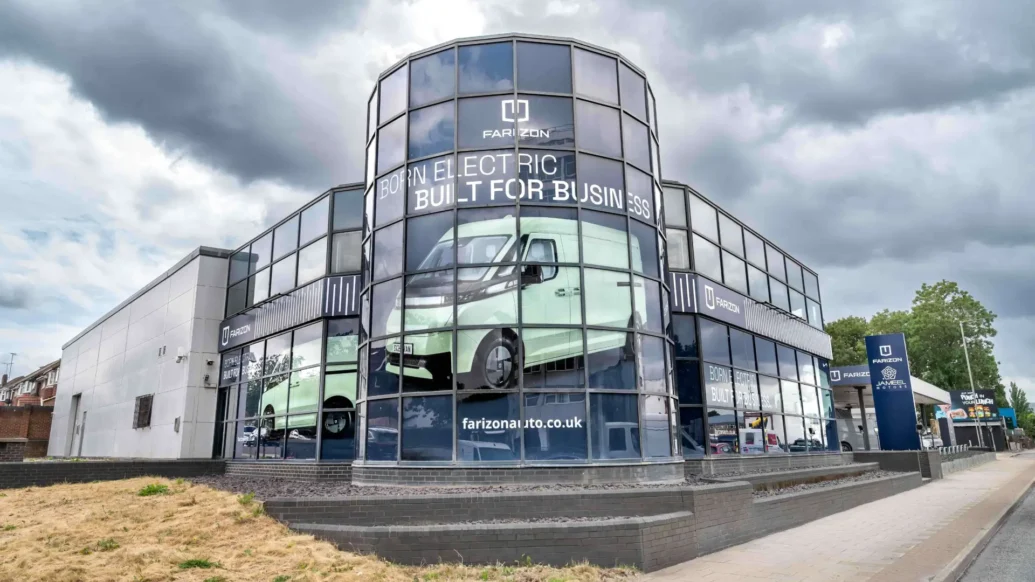
Geely Farizon has admitted that establishing itself in Europe will be “extremely challenging”, despite the Chinese electric commercial vehicle manufacturer having sold more than 600,000 vehicles globally.
Speaking at IAA Transportation in Hanover, Farizon New Energy Commercial Vehicle Group CEO Mike Fan acknowledged that the company’s scale in China and backing from its parent company, Geely, would not automatically translate into European success.
“This is our first time at IAA,” Fan said. “To be honest, we understand very clearly that truly establishing ourselves here will be extremely challenging.”
Farizon has previously presented itself simply as Farizon in the UK, but the company consistently used the Geely Farizon name throughout its IAA communications, placing greater emphasis on its relationship with the Chinese automotive group.
The manufacturer currently sells the Farizon SV electric van in the UK through Jameel Motors, joined recently by the smaller V7E.
Farizon says its cumulative global sales have now passed 600,000 vehicles, including 126,452 sold between January and August 2026. However, success in the UK has been rather more modest, with just 386 Farizon vans registered in the last 12 months.

Low prices will not be enough
Cook Xue, CEO of Farizon Auto International, said succeeding in Europe would require more than simply undercutting established van manufacturers.
“When people talk about Chinese vehicles, they talk about price, price, price,” Xue said. “No. It is not only about the price of the product.
“We want to cover the whole supply chain and value chain, giving customers a complete package.”
According to Xue, European van buyers increasingly expect manufacturers to provide finance, charging, servicing and other operational support alongside the vehicle itself.
“The product and the local support system must move forward together,” he said.
Farizon has established a European headquarters and subsidiaries in Germany and France, while its distribution network now covers 28 European countries.
A European parts warehouse in Gaggenau, Germany, is said to deliver components across the continent within one to six working days, supported by Farizon’s global parts distribution centre in Ningbo, China.
Xue also revealed that Farizon established a European-based engineering team in the middle of 2026.
“We can provide a rapid supply chain for parts and quick technical solutions through our engineers,” he added.
Farizon turns its attention to residual values
The manufacturer is working with banks, leasing providers, insurers and charging companies to establish what it describes as a local European ecosystem.
Xue also acknowledged the need to manage residual values and demonstrate a competitive total cost of ownership.
That could be particularly important for Farizon and other emerging electric van brands. A competitive initial price can quickly be undermined if operators and leasing companies remain uncertain about future values, parts availability, or how quickly vehicles can be repaired.
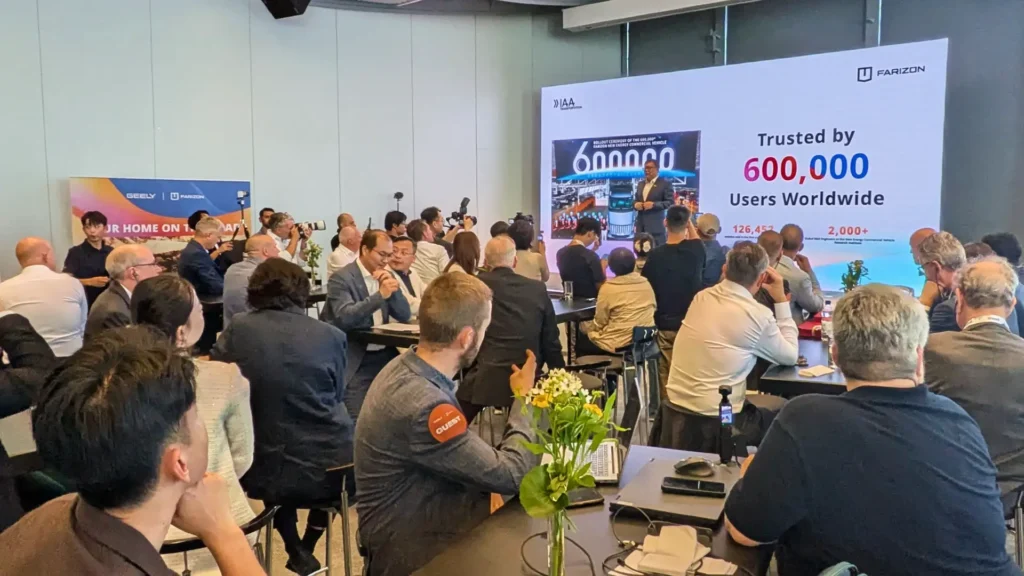
“Delivering a vehicle is only the beginning; it is far from the end,” Fan said.
“Whether customers can make money from freight depends not only on figures written on paper, but on whether the service can support stable, long-term operation.”
Farizon intends to offer local parts supply, aftersales support, finance and intelligent fleet-management services covering the entire vehicle lifecycle.
The comments suggest Farizon is aware of the scepticism facing new commercial vehicle brands in Europe, where operators typically place more importance on uptime, dealer coverage and whole-life costs than on specification or purchase price.
Farizon promises long-term European commitment
Europe is one of Farizon’s most important strategic markets, and the manufacturer intends to become part of the region’s automotive and commercial vehicle supply chains rather than remaining solely an importer.
“For Farizon, globalisation does not simply mean exporting products overseas,” Fan said. “What we are pursuing is an integrated ecosystem and long-term coexistence.”
The company has Geely’s financial, engineering and manufacturing resources behind it, while its SV and V7E offer products developed specifically for electric power rather than converted from diesel vans.
However, building a sufficiently extensive sales and support network — and convincing operators that an unfamiliar brand can protect uptime and residual values over several years — may prove more difficult than developing the vehicles.
Farizon’s executives, at least, appear unusually willing to admit it.

- French Renault Trafic E-Tech pricing offers clues ahead of UK launch - 3 November 2026
- From ice cream to river rescue: Iveco reveals Mission Awards finalists - 2 November 2026
- Tata Motors takes control of Iveco with 89% stake - 2 November 2026