
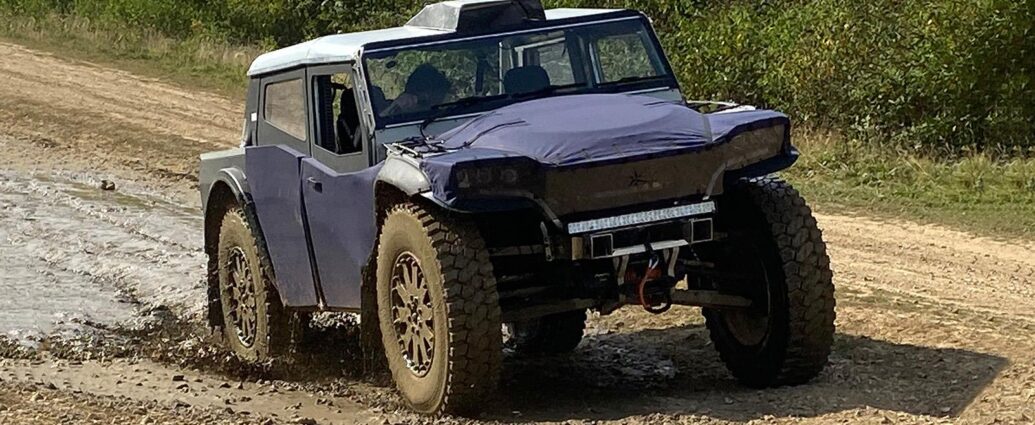
British start-up company Fering is developing the Pioneer, an electric-powered pickup that can cover more than 4,000 miles between charges thanks to an onboard range extender.
Who or what is Fering?
Fering’s founder, Ben Scott-Geddes, has a history of creating and developing pioneering automotive technologies and vehicles. As technical director at Capro, he was responsible for the record-breaking T1 and worked under Gordon Murray building the McLaren F1, and Le Mans winners in 1995.
Scott-Geddes is joined by a host of other talents, including staff with backgrounds in companies as diverse as Red Bull F1, BMW, Sunseeker, Acro Aircraft Seating and the Royal College of Art.
The company was born out of a desire to circumnavigate the globe. A route covering around 35,000 miles was drawn up, but the polar region connecting Canada to Russia proved problematic. A vehicle that can cover 2,500 miles of treacherous sea ice, entirely unsupported by a backup crew, doesn’t exist.
A small team with backgrounds in materials technology, car design, human physiology and global exploration was assembled to reimagine a sustainable and innovative off-grid vehicle with extreme capabilities.
Will it really cover 4,000 miles between charges?
That’s what Fering says, as long as you’ve specified the extended range fuel tanks. There’s a relatively small battery pack under the bodywork that promises a range of around 50 miles, but that’s supported by an 800cc turbo diesel range extender.
That diesel engine operates within its most efficient range, charging the battery pack as it goes. This allows the motors to provide power when under high demand, with the motor topping up the batteries while cruising, braking or coasting.
Using advanced materials and techniques from the circuit and supercars has allowed the Pioneer to be built strong and light. The dry kerb weight is expected to be around 1,500kg so, even without a full charge to start with, Fering estimates that the Pioneer will return 50mpg.
With long-range tanks in place (which we assume to be in the region of 400 litres) it’ll be possible to go off-grid and cover 4,000 miles or so without needing to stop at a filling station.

So it’s a diesel-powered electric pickup?
More or less. A battery provides emissions-free motoring for 50 miles or so, before a range extender generator kicks in to keep you mobile.
Power to the axles is provided solely by two electric motors. These provide instant torque and controllability, giving a total output of 600Nm of torque.
The Pioneer’s battery cells are not the same as you’d find in a conventional electric vehicle, as the usual Lithium-Ion chemistry is affected significantly by extremes of weather – something that’s not helpful in the arctic. Instead, Fering has used Lithium Titanate Oxide cells which are designed to survive extreme weather conditions.
Designed with adaptability in mind, the Pioneer can easily be modified, so bigger batteries and different range extenders can be used, such as alcohol-fuelled engines in Brazil or a fuel cell in Asia.

It looks rugged…
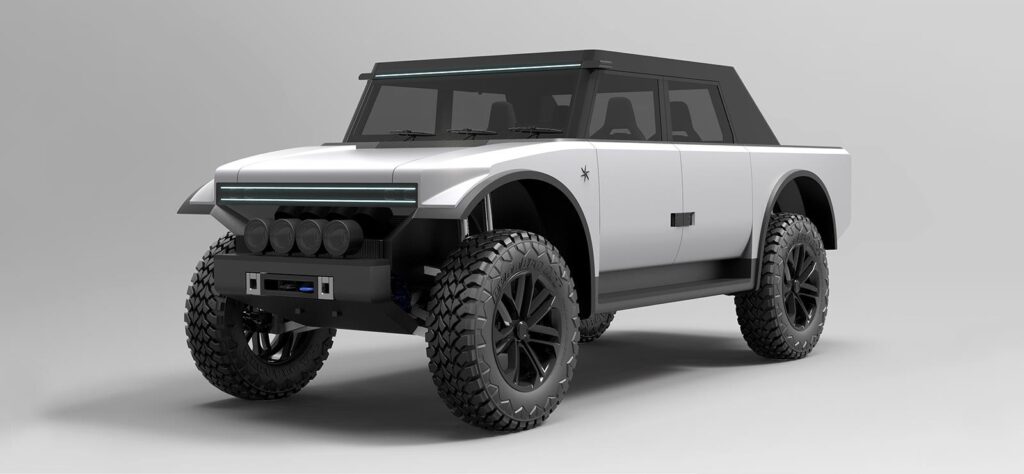
It’s designed to tackle the arctic tundra, so it should be. An aluminium space frame chassis with composite elements provides the bare bones, while the exterior panels are made of tough fabric. This material, which is similar to the canvas found in high-end hiking boots, can shrug off damage, is easily replaced and has better insulation properties than metal skins.
The combination of a battery and generator also makes the Pioneer ideal for emergency service use, where electrically operated rescue equipment and lighting can be used in remote locations, so the vehicle must be capable of reaching every area across every terrain.
Huge 22.5-inch wheels will help cover most ground, but they’re not just for show; the rims are designed to take a standard truck tyre, opening up the possibility of specifying seriously capable all-terrain tyres, and making it easy to replace a damaged tyre in any part of the world.
I bet that pickup bed won’t take a tonne!
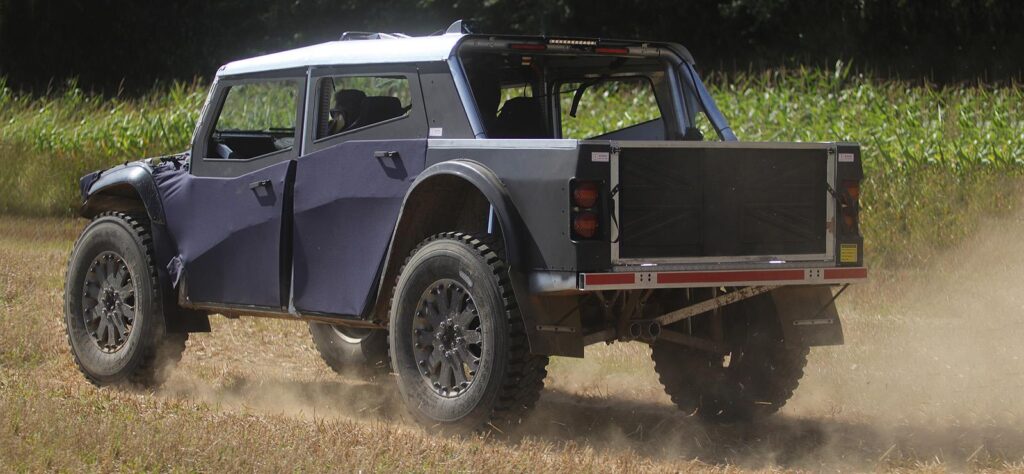
The whole vehicle is more compact than it might look, being broadly similar in size to a Ford Mondeo than a huge pickup truck. Despite that, Fering is confident that it’ll carry a 1.5-tonne payload thanks to the advanced lightweight construction.
So yes, you’ll be able to carry a tonne, and you’ll be able to carry it virtually anywhere.
When can I buy one?
Not yet. The first prototype Pioneer is currently going through testing and being assessed by early customers and organisations. Series production will start in the UK during the first half of 2022. There are no firm prices yet, but don’t expect any change from £150,000.
- Isuzu D-Max 2.2 review: Making less noise about its capabilities
- Farizon SV electric van to gain faster charging and four-wheel drive

- Geely Farizon admits European expansion will be ‘extremely challenging’

- Electric Van Man plugs market gap with UK’s first dedicated used electric van dealership
- Stellantis sets 2029 date for next-generation large van

- Isuzu D-Max 2.2 review: Making less noise about its capabilities - 19 September 2026
- Farizon SV electric van to gain faster charging and four-wheel drive - 18 September 2026
- Geely Farizon admits European expansion will be ‘extremely challenging’ - 18 September 2026