
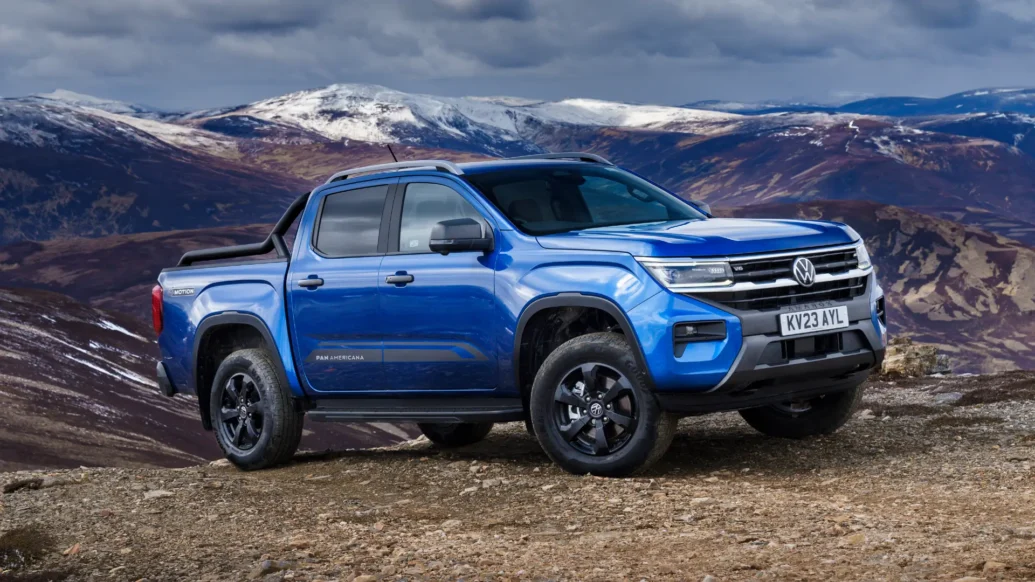
Volkswagen has quietly pulled the plug on its electrified Amarok plans, shelving both plug-in hybrid and fully electric versions that were once “seriously under consideration.”
The decision means the brand’s global pickup will stick with diesel and petrol power for the foreseeable future, even as its near-identical sibling, the Ford Ranger, goes hybrid.
The global Amarok, launched in 2022 and built alongside the Ford Ranger in South Africa, was designed with electrification in mind. Ford has since unveiled the Ranger Plug-in Hybrid, pairing a 2.3-litre turbocharged petrol engine with an electric motor and an 11.8 kWh battery good for roughly 25 miles of EV running.
Volkswagen, however, has decided to sit this one out. Speaking to CarExpert , Nathan Johnson, Volkswagen Commercial Vehicles’ brand director in Australia, explained that CEO Stefan Mecha “made it clear … the PHEV and BEV Amarok is no longer being discussed at this point in time, in this generation,” calling it a global decision.
In short, there’ll be no hybrid or electric power for this generation of Amarok.
Why the change of direction?
Only a few months ago, Volkswagen insiders were openly talking about exploring a plug-in hybrid Amarok, particularly as the technology was already available through Ford. But priorities appear to have shifted.
The official line is that the brand wants to remain “self-sustainable without an impact to the customer,” focusing on keeping prices stable rather than chasing emissions credits or regulatory incentives.
The subtext, however, is simpler: the Amarok sells well as it is, at least in territories like Australia, and the cost of adapting Ford’s hybrid system for Volkswagen’s version might not make commercial sense for what remains a niche product in most global markets.
For the time being, then, the Amarok will remain diesel-powered. The 2.0-litre and 3.0-litre TDI engines will continue to do the heavy lifting. Diesel still dominates the pickup world, especially in regions where these vehicles earn their keep towing, hauling or working off-road.

A tale of two Amaroks
Interestingly, Volkswagen hasn’t abandoned the idea of hybridisation entirely — it’s just happening elsewhere.
In South America, the company continues to produce the original Amarok on Volkswagen’s own chassis, and a new hybrid successor is already under development for 2027. That truck will be built in Argentina using a ladder-frame platform developed with Chinese partner SAIC, and will share technology with the Maxus Terron 9.
The result is a split strategy: a traditional diesel Amarok for Europe, Africa and Australasia, and a hybrid-ready model for Latin America. Don’t expect the two to meet in the middle any time soon.
What it means for UK buyers
Volkswagen’s decision changes little for UK buyers in the short term. The current Amarok’s Ford-derived platform and diesel engines remain among the best in the business for towing and long-distance work.
But it does highlight a growing divergence in approach between the two brands. With Ford launching the Ranger PHEV, buyers seeking a plug-in pickup will have only one option out of the pair.
Volkswagen’s statement that electrification is “not being discussed in this generation” leaves the door open for the future. The next Amarok, likely due in the early 2030s, is almost certainly going to feature some form of hybrid or electric power as regulations across the world tighten. Whether that is through continued collaboration with Ford or a return to an in-house design remains unknown.
By sitting back, Volkswagen can watch how the market reacts to electrification, and whether hybrid or electric pickups genuinely shift the needle in sales, emissions, or brand perception.

- Farizon SV electric van to gain faster charging and four-wheel drive - 18 September 2026
- Geely Farizon admits European expansion will be ‘extremely challenging’ - 18 September 2026
- Electric Van Man plugs market gap with UK’s first dedicated used electric van dealership - 17 September 2026