

Making an electric pickup truck is easy, but making an electric pickup viable for UK businesses is a far more difficult prospect. Toyota walks a tightrope with its new Hilux BEV, an all-electric version of the legendary pickup that’s been so heavily revised that Toyota calls it all-new.
While the fundamentals remain familiar, the execution feels fresh. The basic ladder-frame chassis — an ideal place to hide a load of batteries — is much the same as it’s been for years, though it’s had more than a few updates to strengthen and improve it. The bodyshell is the same as before, too, with the central cab an obvious carryover from the old model. But, at a glance, this is unlike any Hilux that’s come before, and that’s before you open the bonnet.
For decades, the Hilux’s identity has been forged in the clatter of diesel engines. Now it hums in silence, a bright blue charging cable its most striking accessory. Toyota insists the Hilux BEV (battery electric vehicle) isn’t a lifestyle experiment but a working vehicle shaped by the needs of its most demanding customers. Forestry services, airport fleets, utilities — all have helped define the parameters of what Toyota thinks an electric pickup can be. And those parameters are narrow by design.

With weight limits forced upon them by driver licensing restrictions and operator licensing issues, range, payload, and towing have been compromised. But the core of the pickup hasn’t, so it remains tough, capable and reliable. The result is a machine that can travel only around 150 miles per charge, carry 715kg, and tow 1.6 tonnes, yet still wade through 700mm of water and crawl up rocks with the same composure as the diesel model.
Toyota Hilux BEV on and off-road
Press the starter button and… nothing. Just a faint click as the systems boot up. Select “Drive” using a small stubby selector borrowed from Lexus, ease off the brake, and the Hilux BEV glides away without a murmur.
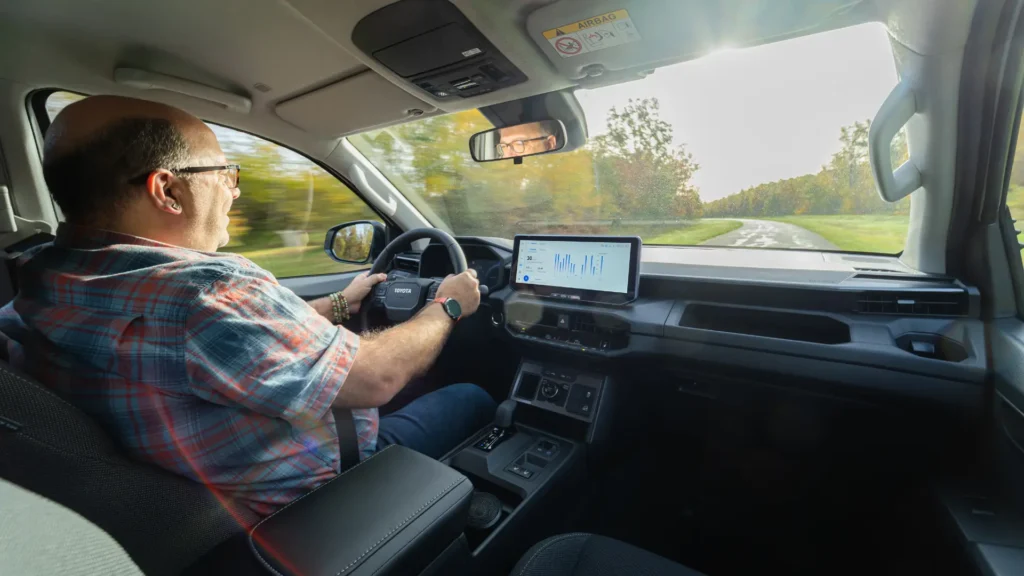
Two e-motors — one on each axle — combine for 196hp, while torque is split 206Nm front, 269Nm rear. There’s instant response from the motors, although Toyota hasn’t chased headline-grabbing acceleration figures. Instead, the focus is on precision. Off the line, it’s brisk enough, easily sub-10 seconds to 62mph, and strong through mid-range overtakes thanks to the absence of gear changes.
The payoff of electrification is refinement. The usual diesel clatter has been replaced by silence, and the BEV’s low-mounted 59.2kWh battery lends it a calm, settled ride that the standard Hilux can only dream of. On the smooth tarmac we tried it on, it feels almost SUV-like — honestly, it’s that refined. Even at 70mph, it’s quieter than the Invincible X diesel ever was.
On coarse surfaces, like the strip of cobblestones we came across, there’s still some jiggle from the leaf-sprung rear, but overall comfort is far improved.

The steering is light but slower than expected, requiring a fair bit of arm-twirling in tighter spaces. It’s not unpleasant, but it can leave the Hilux feeling a little lazy, especially on a mini roundabout. It grips well, though, even on all-terrain tyres, although the front end can wash wide under power as the nose lifts, while the back can feel a little frisky when powering out of corners on a damp surface.
Off-road is where the Hilux BEV really earns its keep. The first time you roll into a rutted track is surreal. You hear stones under the tyres and clanking against the wheel arches, the faint whine of motors, and little else.
Gone are the diff locks and low-range gears; in their place, Toyota’s clever Multi-Terrain Select system. You simply choose from Rock, Mud, Sand, Dirt or Mogul, and the truck sorts out the rest, adjusting throttle, motor response, and traction in milliseconds. Or, if you’re really lazy, just leave it in Auto mode. The Hilux BEV will spend a few seconds working out what surface you’ve managed to get stuck on, and then react accordingly. Even when trying to get bogged down in deep sand or stopping on a steep, muddy climb, the pickup soon figured out what to do.

It’s impressively capable, with approach and departure angles (29° and 24°) matching the diesel model. The only casualty is the breakover angle, down four degrees to 20° because of the battery’s position between the ladder-frame rails, which also lowers the ground clearance to 207mm.
That battery might be modest in size, but it’s seriously well protected. A full-length skid plate protects it from below, while reinforced chassis rails prevent flex or puncture damage. Toyota’s engineers are adamant this truck is just as durable as any Hilux before it, and given the brand’s history, you’d be brave to bet otherwise.

Interior and Tech
Step inside, and the BEV feels more Land Cruiser than Hilux. The cabin has been completely redesigned, with a more upright dash and a rugged but modern aesthetic.
A 12.3-inch central touchscreen handles navigation, media and connectivity, flanked by physical climate controls. Ahead of the driver, a digital display can show everything from battery flow to motor torque split, although its menus take a little learning. Materials are tougher than they look — there are lots of solid plastics and grained finishes that will shrug off dirty boots, but there’s also a genuine uplift in ambience.
Toyota’s ergonomic rethink extends to the details: cupholders by the A-pillars, big storage bins, and proper USB-C sockets front and rear. The seats are broad and supportive, visibility is excellent, and the steering wheel now adjusts for both reach and rake. Rear legroom remains snug for taller adults, but overall, it’s a huge improvement on the utilitarian cabins of older Hilux generations.

Beyond leather seats and folding covers for the cupholders and upper glovebox, we couldn’t see any significant difference between our entry-level model and the higher-spec vehicles.
Payload and practicality
Let’s address the obvious. This isn’t the Hilux for farmers hauling livestock trailers or builders lugging cement bags all day. The BEV’s 715kg payload puts it below the one-tonne threshold required for commercial classification, meaning no VAT reclaim and less favourable business taxation. That said, Benefit-in-Kind rates will be significantly lower thanks to its zero-emission status.
The 1.6-tonne towing limit also narrows its working brief, though for lighter utility use — quad bikes, small trailers, generators — it’s adequate. The bed itself is unchanged at 1,555mm long and 1,540mm wide, with minimal wheel-arch intrusion, so physical space isn’t an issue.

Charging is refreshingly brisk: 150kW DC capability gets you from 10-80% in under half an hour, while a regular home charger will complete an empty-to-full charge in about eight hours.
For most of Toyota’s target users — we’re thinking local authority fleets, airport operations, forestry contractors — that will be more than sufficient. Daily mileage rarely exceeds 80–100 miles, and overnight charging ensures it’s always ready for another shift.
Toyota Hilux BEV: The verdict
If you approach the Toyota Hilux BEV expecting it to do everything a diesel can, you’ll leave disappointed. But that’s missing the point. This isn’t a straight replacement — it’s a carefully targeted tool built for specific users who value reliability, off-road capability, and zero-emission operation over outright hauling power.
It’s not replacing the diesel model, and while the government still allows oil-burning vehicles to be sold, there are no plans to replace it.

What Toyota’s achieved is remarkable in context: a fully electric pickup that still feels like a Hilux. It’s tough, quiet, comfortable and capable, and although the numbers on paper might look modest, in the real world it makes sense for fleets operating in low-emission zones or controlled sites.
The Hilux BEV won’t win over traditionalists, but it sets the tone for where working pickups are headed, and it does so with typical Toyota competence. For those who need to go anywhere yet tread lightly, this electric Hilux is already ready for work.
Model tested: Toyota Hilux BEV
Price: Estimated at £50,000 plus VAT
Professional Pickup rating: ★★★★☆ (subject to final pricing and specs)

- Farizon SV electric van to gain faster charging and four-wheel drive - 18 September 2026
- Geely Farizon admits European expansion will be ‘extremely challenging’ - 18 September 2026
- Electric Van Man plugs market gap with UK’s first dedicated used electric van dealership - 17 September 2026