
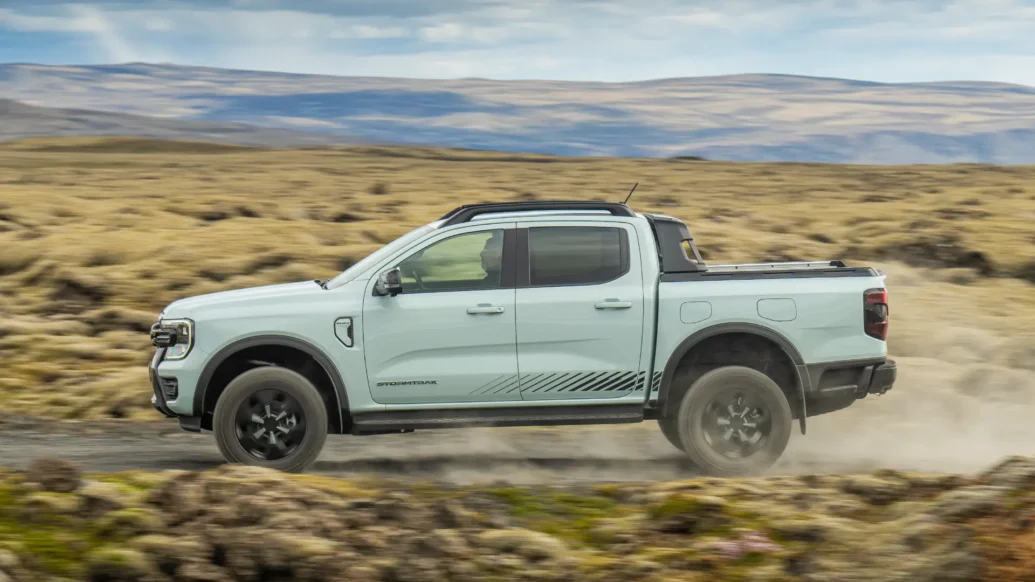
Ford is set to cut around 470 jobs in South Africa, with weaker-than-expected demand for the Ranger PHEV at the heart of the issue.
The redundancies, representing about 9% of Ford’s workforce at its Silverton assembly plant in Pretoria and Struandale engine plant in Gqeberha, come as production volumes are scaled back. Ford has confirmed to Reuters that Silverton has moved from three shifts to two, with output expected to reach just 100,000 units this year — far short of the plant’s 200,000-vehicle capacity.
Ford Ranger PHEV struggles to gain traction
Production of the Ranger PHEV only began in March 2025, with exports targeting Australia, New Zealand and Europe. However, demand has not met Ford’s expectations, particularly in the UK, where the model has been hit hard by the government’s double-cab tax changes.
Until recently, pickups with a payload of one tonne or more were classed as light commercial vehicles, qualifying them for lower benefit-in-kind (BIK) tax rates when used as company vehicles. That regime ended earlier this year, with double-cabs reclassified as passenger cars and company car tax being based on CO2 emissions. The result is significantly higher charges, stripping away a major incentive for business buyers to choose pickups, even relatively low CO2 models like the Ranger PHEV.
Neale Hill, President of Ford Motor Company Africa, told Reuters that the reclassification has “had a big impact in terms of our European orders,” compounding the challenges of launching an expensive PHEV into a highly price-sensitive market.
Global pressures
Ford also faces other export headwinds. Vehicles shipped from South Africa into the US are subject to a 30% tariff, while a lack of European-originating content means Ranger PHEVs cannot enter the EU duty-free. At the same time, South Africa’s domestic market is seeing rising imports from India and China, where brands such as Mahindra and Tata are gaining traction with more affordable models.
Ford says its installed annual capacity at Silverton will now be capped at 140,000 vehicles, though it expects actual volumes to sit closer to 100,000 for the foreseeable future.

- Farizon SV electric van to gain faster charging and four-wheel drive - 18 September 2026
- Geely Farizon admits European expansion will be ‘extremely challenging’ - 18 September 2026
- Electric Van Man plugs market gap with UK’s first dedicated used electric van dealership - 17 September 2026