

The Renault Trafic has been around for quite a while, but a recent facelift means it’s worth a review to see if it’s still got what it takes to compete with fresher rivals.
First introduced in 2014, Renault has sold the Trafic under several different names; it was once available as a Fiat Talento or Vauxhall Vivaro before the two brands were taken over by Stellantis, the parent company of Citroen and Peugeot. The Australian market once even got a Mitsubishi version. You can still find it wearing a Nissan badge, though, where it’s known as the NV300 or Primastar.
Despite getting relatively long in the tooth (and with no electric version being available), the latest updates make the van, on paper, competitive against the class-leading Ford Transit Custom and the Volkswagen Transporter.

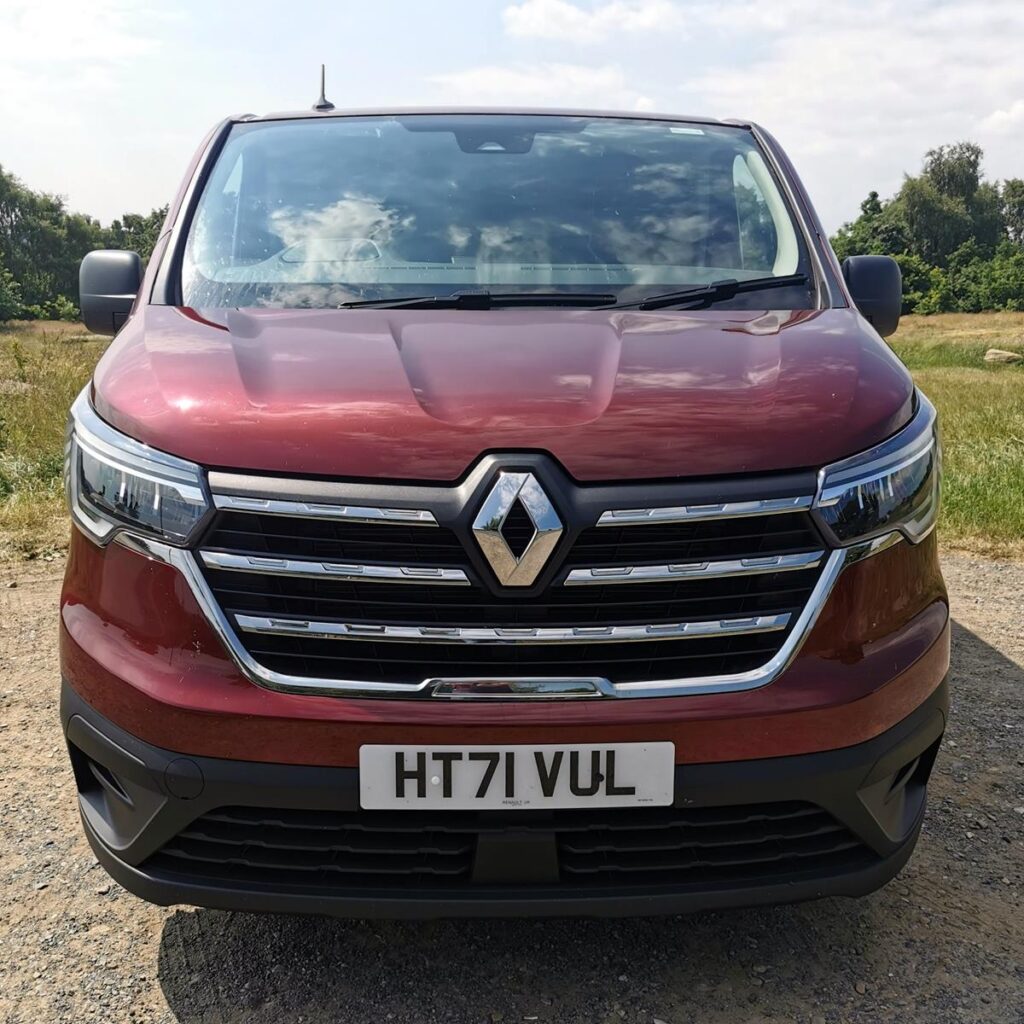
Now marketed as the Trafic Blue, the basic exterior profile remains unchanged. However, there have been some striking visual improvements at the front. There’s a new imposing grille with LED lighting, incorporating Renault’s C-shaped daytime running lights. Underneath, a new front bumper brings the Renault bang up to date.
The cab has also been refreshed, with a new dashboard and instrument panel, new door cards, and other minor, detailed improvements. Renault has taken previous criticism on board regarding some safety aspects, the latest van now being offered with some ADAS (Advanced Driver Assistance Systems) as standard. However, most are still relegated to the options list.
The Trafic is now offered in four trim levels. The model we’re testing is the entry-level Business specification aimed at the fleet market. It isn’t blessed with too many bells and whistles, but there’s a DAB radio with Bluetooth connectivity, electric windows, cruise control and a Thatcham-approved alarm to help keep things secure.

Business+ adds an 8.0-inch infotainment touchscreen with Android Auto and Apple CarPlay smartphone integration, alongside air conditioning and rear parking sensors. Sport trim boasts 17-inch alloy wheels, a body-coloured front bumper and electric folding door mirrors on the exterior, whilst the cabin infotainment system gains navigation services. There’s snazzier trim with horizontal grain and chrome styling, and the upholstery is given a makeover. The Trafic gains automatic emergency braking and driver attention alert at this point in the range. Range-topping Sport+ comes with climate control and a rear parking camera, and further safety features added are lane departure warning and traffic sign recognition. Alloy wheels with black inserts add a flourish to the exterior, as do the body-coloured side mouldings.
Renault Trafic: Cabin
The revised cab is modern and welcoming but also functional. The layout isn’t pretentious, and everything is where it should be, although the absence of a touchscreen on this base Business model is very noticeable. Instead, there’s a very simple and small display for the radio and Bluetooth functions, but higher specification models benefit from an 8.0-inch touchscreen.

If it wasn’t for the lack of a bit of luxury, you could argue that the cabin is as car-like as you’ll find in any van, as it takes a lot of inspiration from Renault’s road cars.
Renault has done a great job in suppressing noise in the cab. Engine, road, and wind sounds are minimal, adding a sense of refinement to the cabin.
The seating is comfortable and looks good, but whilst storage in the cab is limited, there are fair-sized door bins and a handy dashtop tray. Renault says there are 84 litres available in all the cubby holes, pockets and glove boxes, although more than half of that is hidden under the passenger seat. The two-person bench seat is a good size, with three-up travel not being something to dread thanks to more elbow room than its Stellantis rivals and a decent amount of knee room for the centre passenger.
Renault Trafic: On the Road
A 2019 update saw the old 1.6-litre diesel engines replaced by more modern 2.0-litre units, currently offered at outputs of 110hp, 130hp, 150hp and 170hp. The two higher output engines are available with a six-speed dual-clutch automatic gearbox as an option in place of the standard manual transmission.
The 110hp version is a new introduction, brought in at the same time as the facelift. These days, a 110hp engine might be considered underpowered, but this wasn’t evident in practice. If I hadn’t known, I’d have guessed that the van had at least the 130hp version, possibly even the 150hp unit, such was the sensation of performance. The official figures suggest a somewhat tepid 0-62mph time of 16.8 seconds, but, in practice, acceleration felt relatively rapid. Although the van was tested unladen, long gradients posed no issue or necessitated downward gear changes.

The only downside with the powertrain? The gearshift has quite a long throw and felt a little dated in operation. We’ve had a taste of the automatic models, though; they’re impressive, with smooth and quick changes.
The Trafic is pleasant to drive – almost as lovely as the Transit Custom, which is high praise indeed. It handles well, the steering is responsive, and it stops on a sixpence thanks to the all-around disc brakes.
Renault Trafic: Economy and Running Costs
As tested, this entry point to the Trafic range has a list price of £27,450 plus VAT, bulked up to a hefty £30,570 once the options are added. Renault’s pricing strategy for this additional equipment seems erratic; £133 for an aluminium roof rack designed to fit perfectly looks pretty reasonable, but £1,666 for a ladder on the rear door to get to it? Or £455 for ply-lined side panels in the cargo area? I can’t see many buyers taking up that option, as a local ply lining company will do at least as good a job for a fraction of that figure.
Some strong finance options from Renault are available to minimise the pain, with a four-year lease-purchase package for under £300 a month. That also includes servicing, although there’s a hefty deposit and balloon payment.


Fuel economy, at least officially, sits at 40.9mpg. That correlates reasonably well with the onboard computers recording of my time with the van, with the display consistently settling into the high 30s.
Servicing is every 24,000 miles or two years, and the van is covered by a three-year or 100,000-mile warranty, as well as roadside assistance for the same time.
Renault Trafic: Payload and Towing
Short and long wheelbase (L1 and L2) versions of the Trafic are available, and buyers can specify a high roof on either. The all-important internal lengths are 2,537mm and 2,937mm, respectively – the longest load area in the segment. With a load-through panel in the bulkhead, smaller objects up to 3,750mm long could squeeze into the L1 van, with another 400mm for the L2 versions.
The H1 has an internal height of 1,387mm, with the H2 being a little more spacious, offering an interior height of 1,898mm. Combined with an internal width of 1,662mm (dropping to 1,268mm between the wheel arches), the load volumes range from 5.8m3 to 8.9m3.

The van has a side loading door and twin rear doors in standard configuration, with a second side door and tailgate available as options. There are plenty of load lashing points within the loadspace, and a steel bulkhead is fitted.
There are two badged weight versions, at around 2,800kg and 3,000kg GVM. Renault says that payloads run from 935 to 1,251kg, depending on specification.
This 110hp model is limited to towing a trailer of up to 2,000kg, although higher power models extend that to 2,500kg. That’s only true when coupled to a manual gearbox, though, as the automatic models see that limit cut down to as low as 1,630kg.
| Kerb weight | 1,867kg | Load bay length | 2,538mm |
| Gross vehicle weight (MAM) | 4,800kg | Load bay width | 1,662mm |
| Payload | 1,017kg | Load bay height | 1,387mm |
| Gross vehicle mass | 2,800kg | Load bay capacity | 5.8m3 |
| Towing capacity (braked) | 750kg | Towing capacity (unbraked) | 2,000kg |
Renault Trafic: Verdict
Given the age of the Renault Trafic, there were some preconceptions. It would feel dated, lacking in technology, and tired to drive, at least compared to the Ford Transit Custom and Volkswagen Transporter.
I was wrong. The van was an absolute pleasure to drive. Build quality seemed first class, with the only flaw being a squeaking from the ply-lining in the loadspace. It looks good, too, especially from the front. Equipment levels at each trim point seem right compared to the competition, especially as Ford now has standardised air conditioning in the mid-range Trend model.
It’s tough to think of an aspect I disliked, apart from the gear change. This van is more than capable of holding its head high in the company of any competitor in the medium van segment. The only issue that Renault has to face is the ever-looming transition to electricity which will probably be the eventual death knell for this incarnation of Trafic, but then a new generation must be well in development by now.
Model tested: Renault Trafic SL28 Blue dCi 110 Business L1H1
| Basic price | £27,450 | On the road inc VAT | £33,985 |
| VAT | £5,490 | Model range exc VAT | £27,450-£37,500 |
- IVECO Mission Awards 2026 Q3: Decarbonisation round-up
- Apollo launches Altrust Winter van tyre with A-rated wet grip
- Chery invests $75m in KGM as Korean manufacturer expands Chinese technology partnerships
- CTEK CS One Gen 2 review: Smart charging to keep your van’s battery in top condition
- Van drivers working almost an hour longer each day, says Volkswagen

