
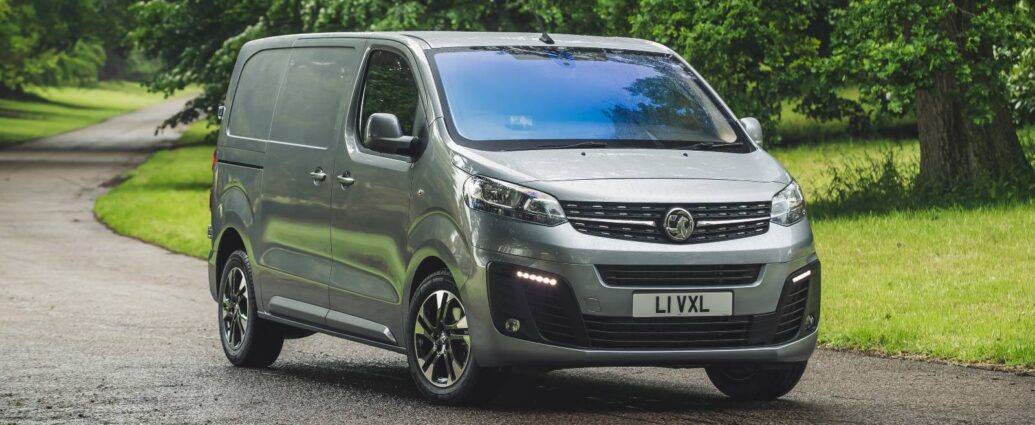
The Vauxhall badge does a lot of heavy lifting, with the Vivaro being the second best-selling medium van in the UK, way ahead of its identical siblings from Citroen and Peugeot. The extensive dealer network and strong finance offers make Vauxhall a top choice for owner-operators and small businesses, second only to Ford and its dominant Transit Custom.
For years, the Vivaro has been little more than a rebadged Renault Trafic, but that had to end when Stellantis purchased Vauxhall. Now it’s little more than a rebadged Peugeot Expert, and while that’s boosted sales significantly, it’s still not troubling Ford too much.

It’s doing well with electrification, though, with the Vivaro-e persistently being the top-selling electric van in the UK. Ford’s new e-Transit Custom won’t arrive for at least another year, so Vauxhall can steal a march on their arch-rivals.
Much of the Vivaro’s popularity can be attributed to the range of models available, with two lengths of panel van, four engines, crew cab and platform cabs, and a range of weights, all with competitive payloads.
Two trim levels, Dynamic and Sportive, are separated by very little, although the latter gains body-coloured side-protection mouldings, front and rear bumpers, and a chrome-effect front grille with LED daytime running lights.
There hasn’t been any update to the design since the model’s introduction as a Vauxhall in 2019, but it still looks good. The boxy design is set off by some shaping to the side panels and kinks in the window line, lending it a modern and functional aesthetic. The Vauxhall grille sits nicely on the van, arguably making it the finest looking version of the five near-identical related vans and arguably the most stylish medium van on the market.
But, with all of those differently badged siblings, is there a reason to pick the Vauxhall over a similar Citroen, Fiat, Peugeot or Toyota? And more importantly, where does it stand against the Ford Transit Custom?

Vauxhall Vivaro Review: Cabin
Step inside the van for the first time, and your initial impression might not be great. While some may talk of the benefits of a simple and functional cabin, others will say that it’s simply dated and rather basic.
The instrument binnacle contains a simple but informative display, while the infotainment system in the dashboard’s centre is clear and reasonably easy to use. It’s the same system you’ll find in the Citroen Dispatch and Peugeot Expert and comes with the same relatively small 7.0-inch screen.
What is impressive is the amount of storage in the cabin. Huge door bins will take a plethora of bottles, newspapers and other detritus. The top of the dash has a large, deep compartment together with cup holders for the driver and passenger. What frustrates me is the shelf under the infotainment centre that looks like a perfect location to keep your smartphone right next to the USB port. At least it would be if it wasn’t too small and hard, turning your phone into a projectile the first time you turn a corner. Something as insignificant as a rubber pad would solve the problem, but that’s not something parent company Stellantis has managed to come up with in six years.
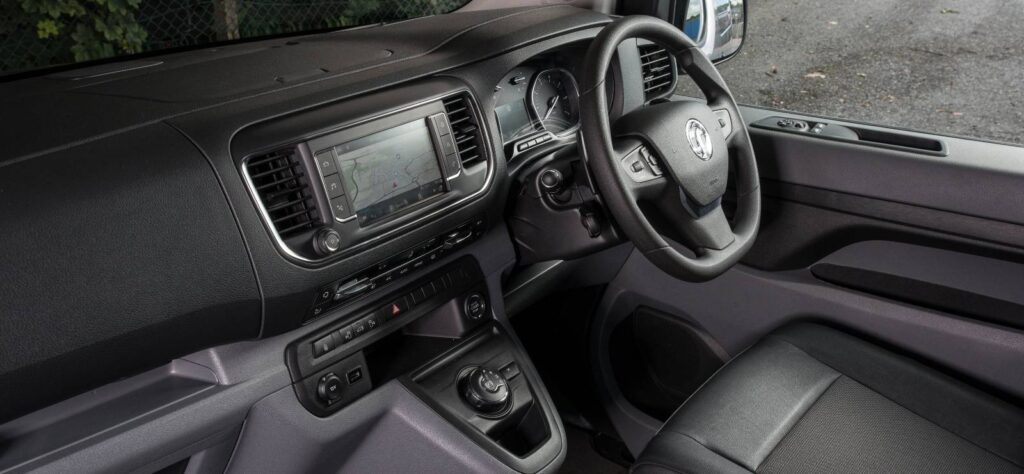
All-round visibility is good, with vision forwards, in particular, free of obstruction. Seating proved very comfortable on a long journey, although the centre passenger will find that the gear lever surround fouls their right leg.
Equipment levels are good across the range. The entry-level Dynamic model might miss out on some exterior bling, but the driver will benefit from air conditioning, cruise control, a 7.0-inch infotainment system, automatic lights and wipers, heated door mirrors and rear parking sensors.
The Sportive model doesn’t add much inside, with the highlights being a fold-flat passenger bench seat and a load-through bulkhead.
Vauxhall Vivaro Review: On the Road
Vauxhall has given buyers the choice of four engines, ranging in power from 100hp to 145hp. There’s a pair of 1.5-litre diesel engines, with 100hp or 120hp available, with 270 or 300Nm respectively. Our test van has the former engine, the lowest power model in the range.
A 2.0-litre engine is available that produces 145hp. With a manual gearbox, as fitted as standard across the range, there’s 340Nm of torque, but opt for the eight-speed automatic, and that increases to 370Nm.

With 100hp available, we were concerned that our Vivaro would feel underpowered, but it proved surprisingly enthusiastic, with a slick six-speed manual gearbox making urban use easy. We couldn’t test the Vivaro with a full load (1,060kg on this model) which is a shame, but experience with other Stellantis models suggests it’ll be fine, if not exactly rocket ship fast.
Handling is unexceptional. The front is very light, with little to provide confidence when heading into twister terrain. On a motorway, it’s solid and stable, though, with a perfectly acceptable ride quality, with noise insulation keeping the cabin quiet.
The driving position is awkward, though, with the steering wheel and pedals perhaps being designed and installed by different teams of people – the offset is significant and leads to sitting in the van with a bit of a twist.
Disappointingly, there’s a lot of safety equipment missing from the Vivaro. While it’s got the mandated stability control and anti-lock brakes, you’ll need to pay extra for curtain and side-impact airbags, lane departure warning, a rearview camera, and even tyre pressure monitoring. Automatic emergency braking isn’t even an option unless you choose the electric Vivaro-e.
Vauxhall Vivaro Review: Economy and Running Costs
Prices for the Vivaro panel van start at £29,496 plus VAT, although our review van – an L2 with the 1.5-litre 100hp engine in Sportive trim – is listed at a more substantial £31,441. Lease rates for the test model seem to hover at around £350 per month, which is quite a bit more than you’ll pay for a similar Ford Transit Custom.
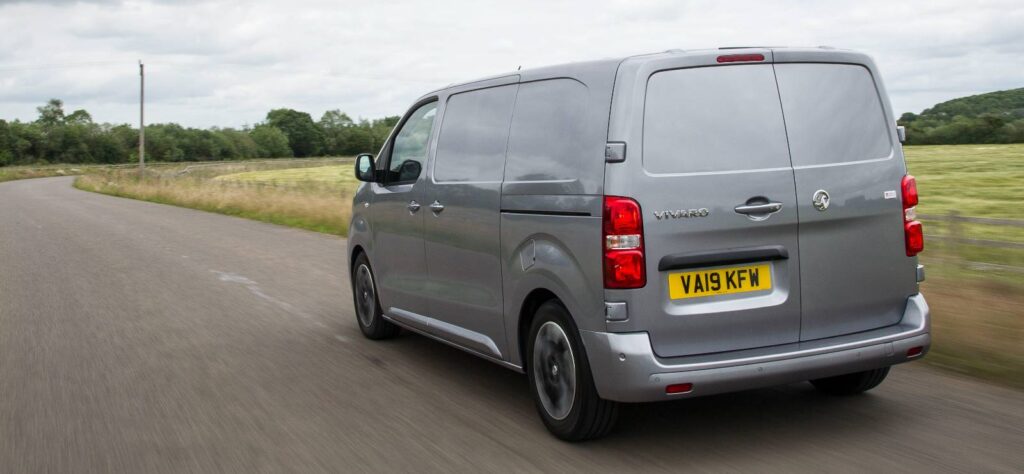
However, buyers can have the van for around £250 a month, which makes it a rather attractive choice, and cheaper than its Citroen, Peugeot and Toyota counterparts. The near-identical Fiat Scudo can be had for a lower monthly outlay, though.
Fuel economy is also competitive, with the van officially able to achieve 41.5mpg. During our time with the van, the onboard computer recorded 36.0mpg, which is reasonably close. Gentler drivers should be able to do even better, although bear in mind that the Vivaro was empty during our review.
Service intervals are set at 25,000 miles or two years on the 1.5-litre engined models, while Vivaros fitted with a 2.0-litre unit can go on for 30,000 miles before needing a dealer visit. The same two-year limit still applies.
Every model is backed by a three-year or 100,000-mile warranty, which will see most through a lease deal. However, owner-operators and small businesses, who tend to run vehicles for longer periods, might be tempted by the identical Toyota Proace with its warranty that can run for as long as ten years.
Vauxhall Vivaro Review: Payload and Towing
The Vivaro is fitted with sliding side doors, one on each side, which makes access to the load area easy, wherever you’ve stopped. Double rear doors are standard, as with most vans, with a lifting tailgate available as an option.
Once inside, the cargo bay is as functional as you’d expect, with good straight sides and minimal wheel arch intrusion. Lashing points on each side are a nice touch, but the lack of decent lighting is disappointing; there are a couple of old-fashioned bulbs but no bright LEDs.

Internal volume on our test van is given as 6.1m3, which is competitive but not class-leading. Loads of up to 2,862mm can be squeezed in, but the load-through panel in the bulkhead on Sportive models can extend that to as much as 4,024mm. The Transit Custom may be slightly larger inside, but it can’t compete with such an extendable cargo zone.
Even if the Transit Custom is a little longer inside, with a larger cargo volume, both can squeeze in three Euro pallets. The Vauxhall has it beaten with payload capacity, though. Our test van, the L2 Sportive, can take 1,060kg, but that’s as low as it goes. The model range runs from this vehicle’s 1,060kg and rises to 1,458kg.

Gross vehicle weights are set at 2,700, 2,900 and 3,100kg, with gross combination weights reaching up to 5.6 tonnes. Towing limits are set at 2.5 tonnes for models powered by the 2.0-litre engine, with lower limits for the 1.5-litre models ranging from 1,800kg to 2,000kg.
| Kerb weight | 1,770kg | Load bay length | 2,862mm |
| Gross vehicle weight (MAM) | 4,830kg | Load bay width | 1,636mm |
| Payload | 1,060kg | Load bay height | 1,397mm |
| Gross vehicle mass | 2,830kg | Load bay capacity | 6.1m3 |
| Towing capacity (braked) | 2,000kg | Towing capacity (unbraked) | 750kg |
Vauxhall Vivaro Review: Verdict
When your main competitor is the Ford Transit Custom, it’s difficult not to make comparisons. The Vauxhall is a little more compact, with a smaller cargo area and a tighter-feeling cabin, a cabin that is a step or two behind the Ford in terms of usability and refinement.
However, the Vivaro manages to carry heavier loads and can be had for some incredibly competitive finance rates . Your running costs against a Transit Custom will be all but identical, so what’s best comes down to what works for you. The Vauxhall edges it if you need maximum payload, but the Ford is more cavernous and nicer to live with.

If the Vauxhall Vivaro is the right option, you’ve also got to consider the Citroen Dispatch, Fiat Scudo and Peugeot Expert, which are all identical beyond the badge. Finance rates will vary between them, so go with the best deal.
Or there’s the Toyota Proace. Aimed squarely at the owner-operator and small business, Toyota has nudged the needle in their favour by including a warranty that can run for as long as 10 years. There are some conditions, but they’re not onerous, which means you’ll have security for the life of your van and way beyond what its siblings can offer. It’s where our money would go.
Model tested: Vauxhall Vivaro 2900 1.5 100PS Sportive L2
| Basic price | £30,513 | On the road inc VAT | £37,661 |
| VAT | £6,103 | Model range exc VAT | £28,568-£33,123 |
- IVECO Mission Awards 2026 Q3: Decarbonisation round-up
- Apollo launches Altrust Winter van tyre with A-rated wet grip
- Chery invests $75m in KGM as Korean manufacturer expands Chinese technology partnerships

- CTEK CS One Gen 2 review: Smart charging to keep your van’s battery in top condition

- Van drivers working almost an hour longer each day, says Volkswagen

