

The new Mercedes-Benz Vito Sport-X is handsome, powerful and impressively comfortable, but there’s one baffling decision that undermines its potential as a combined work and family van.
The Vito is getting on a bit. With an all-new generation expected in the next couple of years, it’s now one of the oldest vans in a fiercely competitive medium van sector.
Mercedes has responded by turning up the style. Developed specifically for the UK, the Vito Sport-X adds 19-inch alloy wheels, a bespoke bodykit, sports seats and a suitably long equipment list to the existing Vito Select.
Available only as a five-seat Crew Van (for now), it’s aimed squarely at the owner-driver who wants something smarter than a conventional working van, somebody looking for one vehicle to cover work and family duties.
Does it pull off that dual-purpose trick? We took a drive to find out.
What is the Mercedes-Benz Vito Sport-X?
Sport-X is a familiar name from Mercedes Vans’ past, and this latest version broadly follows the same pattern as the 2013 model.
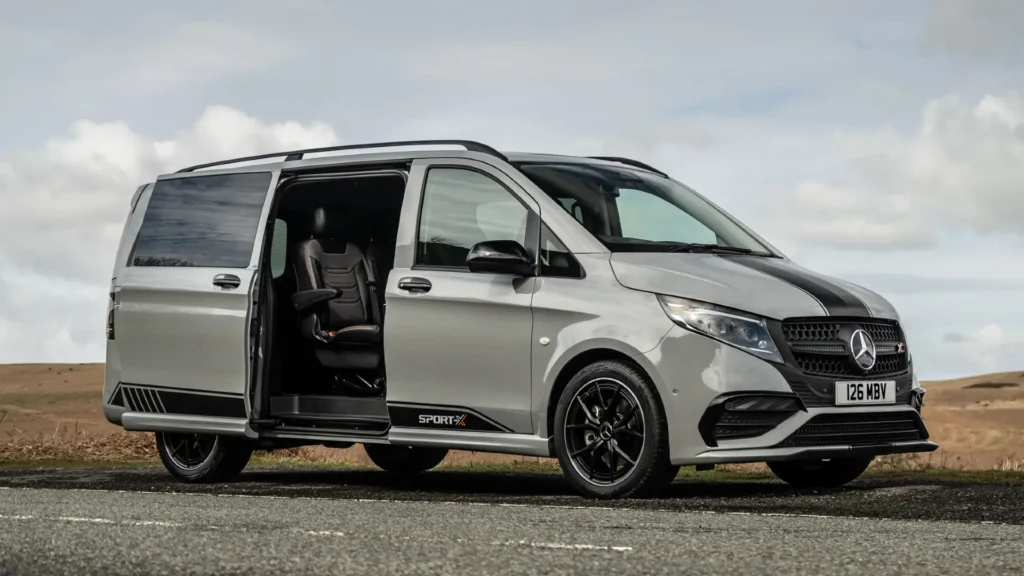
Based on the Select trim, the UK-specific Sport-X is initially available as an L2 or L3 Crew Van. Both versions have five seats, with two individual chairs in the front and a split three-person bench behind.
There’s just one engine, although it’s the obvious choice for a van like this. The 2.0-litre diesel produces 190hp and 440Nm of torque, with drive sent through a nine-speed 9G-Tronic automatic gearbox.
So what makes it a Sport-X rather than a well-specified Select? Mercedes has added sporty bits. Van style can go wrong very quickly when a manufacturer starts adding spoilers, skirts, stripes and oversized wheels, but Mercedes has shown some restraint.
The Sport-X gets a redesigned grille and front bumper with an integrated splitter, side skirts and a body-coloured rear spoiler. Gloss-black mirror caps and door handles complete the look, along with Sport-X badges and decals.
There’s also an optional stripe running over the bonnet, although we think it looks smarter without it.
You’ll also find a set of kerb-attracting 19-inch diamond-cut black alloy wheels. They fill the wheelarches nicely and give the Vito a lower, wider stance without making it look like it has crashed through an aftermarket accessories shop.
You can finish it off in the standard Alpine Grey paint, while Arctic White and six metallic finishes are available as options.
What’s it like inside?
The cabin changes are more important than the bodykit. Mercedes has removed the standard three-person front bench and replaced it with two individual sports seats. That reduces the total seating capacity to five, but it makes the front of the Sport-X a far nicer place to spend time.

The seats have integrated headrests, redesigned bolsters and Sport-X branding. Black artificial leather is combined with dark grey suede-effect material and orange contrast stitching, which continues onto the rear bench.
More importantly, the seats are excellent. They’re supportive around the shoulders and lower back without being excessively firm. They’re also heated in the front, as is the steering wheel.
The Sport-X also gets Mercedes’s MBUX infotainment system, with Apple CarPlay and Android Auto. The dashboard can still feel more commercial than those in the newest medium vans, and some of the touch-sensitive steering-wheel controls are needlessly fiddly. However, the glossy piano-black trim, wireless charging pad and overall finish feel suitably upmarket.
What’s the Vito Sport-X like to drive?
The surprise is how little the 19-inch wheels have damaged the ride quality. Large wheels and low-profile tyres aren’t an obvious recipe for comfort in a van, but the Sport-X remains composed over broken surfaces. It doesn’t crash or thump its way along a typical British road, and the ride never becomes as brittle as its appearance might suggest.

With 190hp and 440Nm available from 1,350rpm, performance is strong without being excessive. It gathers speed easily, has plenty in reserve for joining faster traffic and doesn’t struggle when asked to overtake.
The nine-speed automatic gearbox suits the engine extremely well. Changes are smooth, it generally keeps the diesel in the useful part of its torque band and there’s little reason to interfere with it manually.
Our van was carrying around 150kg during the launch drive, which wasn’t enough to test its working limits, but the additional weight wasn’t noticeable from behind the wheel.
Nobody will mistake the Sport-X for a sports car, but it’s quick, comfortable and more enjoyable to drive than a medium van strictly needs to be.
How practical is the Vito Sport-X?
The L2 version provides 3.6m3 of load volume and a payload of up to 556kg. Moving to the longer L3 increases the loadspace to 4.1m3 and, thanks to its higher gross vehicle weight, raises the maximum payload to 733kg.
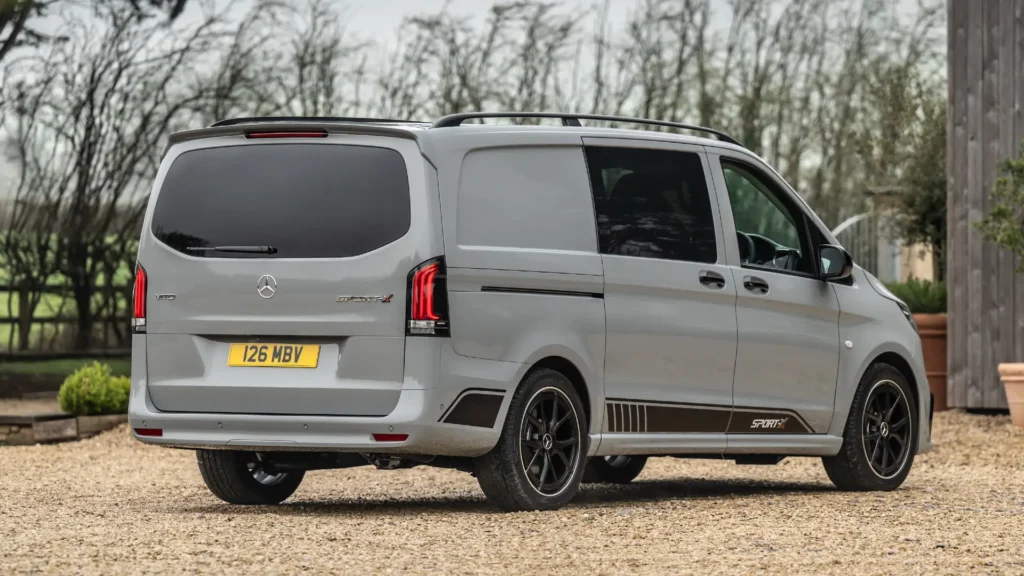
Those figures are some way short of what a dedicated panel van can manage, but they may be adequate for an owner-driver carrying people, tools and lighter equipment.
The second-row bench can also be removed when additional cargo space is required. Towing capacity is 2,000kg as standard, with the option to increase it to 2,500kg.
In reality, this is unlikely to be bought as a hard-working fleet vehicle. Its price, equipment and five-seat layout make far more sense for a sole trader who wants one smart van to cover both business and family use.
That’s where we encounter the Sport-X’s most frustrating flaw.
The Vito Sport-X has a baffling Isofix layout
There are two Isofix child-seat positions on the rear bench, but Mercedes has placed them on the centre and right-hand seats rather than on the two outer seats.

That means the mountings sit directly alongside one another. Two normal child seats are too wide to fit properly in those adjacent positions, making it effectively impossible to use both Isofix points at the same time.
In practical terms, this enormous five-seat van can accommodate only one typical Isofix child seat.
A second child might be carried in an appropriate seat secured using the vehicle’s seatbelt, but that doesn’t excuse such a poor layout. Putting the mountings on the left- and right-hand rear seats would have allowed two Isofix seats to be installed with space between them, as buyers would reasonably expect.
It’s an extraordinary oversight in a vehicle that otherwise appears ideally suited to combined work and family use. Anyone with two young children should take their own seats to the dealership and check the arrangement carefully before buying.
How much does the Mercedes Vito Sport-X cost?
Brace yourself. Prices start at £56,995 excluding VAT, so the Sport-X requires a considerable leap from the more commercial parts of the Vito range.

You do get plenty for the money. The bespoke exterior components, 19-inch wheels, excellent sports seats, upgraded upholstery, heated steering wheel and additional equipment go well beyond a token trim-level exercise.
Claimed fuel economy of up to 38.7mpg is reasonable for a powerful diesel Crew Van, and the real-world 38.2mpg we managed is relatively impressive.
The Vito is covered by a three-year, unlimited-mileage warranty. Mercedes also includes MobiloVan roadside assistance during the warranty period. That can be renewed without an additional charge when the van is serviced within the authorised Mercedes network, potentially providing cover for up to 30 years from its first registration.
Mercedes Vito Sport-X first drive verdict
The Mercedes Vito Sport-X is far more convincing than a van with a bodykit and 19-inch wheels has any right to be. It looks smart without becoming ridiculous, the interior upgrades make a meaningful difference and its excellent ride hasn’t been sacrificed in pursuit of a sportier appearance.
Its limited payload and £57k starting price mean it isn’t a conventional workhorse. Instead, it makes most sense as a sole trader’s do-everything vehicle: presentable enough for family duties at the weekend but still capable of carrying people, tools and equipment during the week.
That makes the badly conceived Isofix arrangement particularly disappointing. Mercedes has created a vast five-seat van that should be ideal for a working parent, then made it practically impossible to install two typical Isofix child seats.
Nobody needs a Vito with sports seats, a bodykit and enormous alloy wheels, but it’s easy to understand why somebody might want one. Just make sure the children fit before signing the finance agreement.

- Farizon SV electric van to gain faster charging and four-wheel drive - 18 September 2026
- Geely Farizon admits European expansion will be ‘extremely challenging’ - 18 September 2026
- Electric Van Man plugs market gap with UK’s first dedicated used electric van dealership - 17 September 2026