
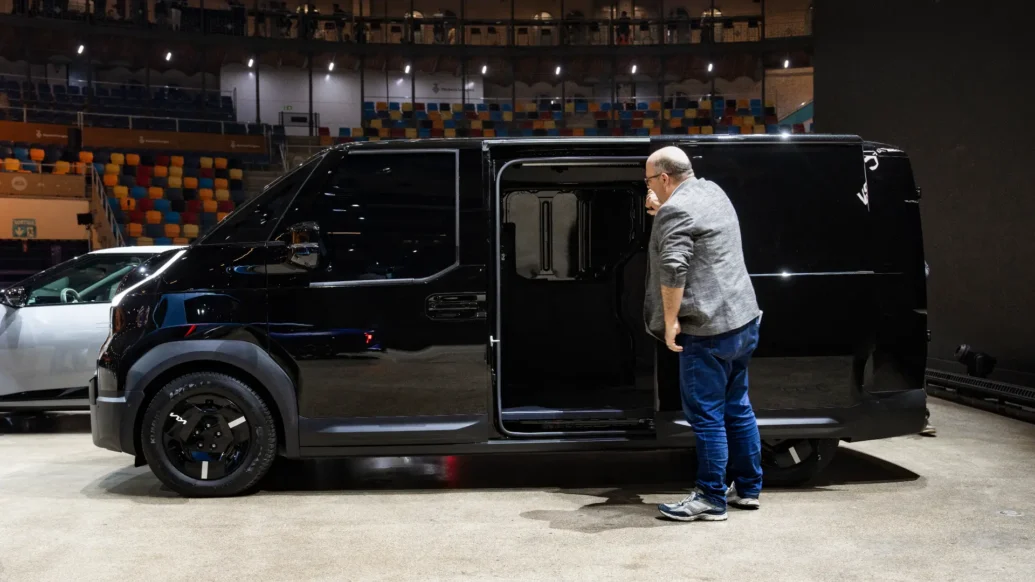
Kia has officially lifted the lid on the PV5, a new electric van that promises to shake up the light commercial vehicle (LCV) sector with its modular design, high-tech connectivity, and efficient battery options. Revealed at Kia’s EV Day, the PV5 is the first production model in Kia’s ‘Platform Beyond Vehicle’ strategy, showcasing the brand’s entry into the European van market while also showing its vision for next-generation commercial mobility.

A van with versatility at its core
Designed as a mid-sized van — it’s slightly smaller than a Ford E-Transit Custom — the PV5 will be available in three configurations from launch: Passenger, Cargo, and Chassis Cab. Built on Kia’s new ‘E-GMP.S’ platform — a dedicated electric ‘skateboard’ chassis — the PV5 can accommodate multiple body styles and interior layouts, offering exceptional adaptability.
For businesses requiring a workhorse that balances efficiency, practicality, and customisation, the PV5 Cargo promises a lot.
Available in two lengths and with two height options, it boasts a maximum load capacity of 5.1 cubic metres — enough to fit two Euro pallets comfortably.

However, Kia executives revealed that the PV5 weighs 2.65 tonnes. If that’s correct, the payload will be limited to just 850kg. That’s around 200kg less than a Ford E-Transit Custom, although comfortably higher than a Volkswagen ID Buzz Cargo’s 607kg limit.
A low step height into the cargo bay of just 419mm is impressive, reducing the strain of loading and unloading heavy goods. This has been achieved by carving out some of the floor between the van’s structure, leaving a far lower platform, albeit one that’s relatively narrow.
For further ease of access, the High Roof specification offers a walk-through option with a sinking passenger seat and a sliding partition, allowing quick movement between the cabin and cargo area without exiting the vehicle.

Kia has taken a fresh approach to interior storage, integrating an optional L-track mounting system into the cargo box. This enables loads to be secured flexibly using sliding tie-down rings positioned in multiple locations along the cargo area, headlining, and partition wall.
Kia PV5: Power, range, and charging
Kia will offer the PV5 with multiple battery options: a 51.5kWh or 71.2kWh NCM battery across all models, and an additional 43.3kWh LFP option for the Cargo variant.
Solid-state batteries are notable for their absence, despite manufacturers saying they’re just a few years away. Spencer Cho, Head of Strategic Business Planning Division at Kia Worldwide, touched on this, telling Professional Van: “Every OEM is talking about the development of solid-state batteries. Internally, we believe that commercial versions might be ready by 2030, but nothing is available in commercial volumes yet.”
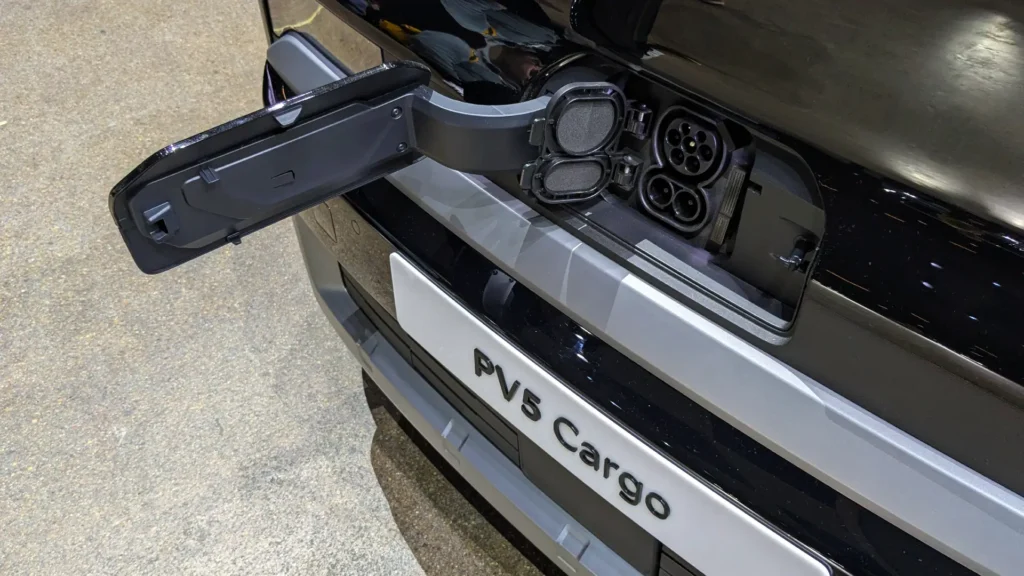
Power is delivered through a front-mounted electric motor producing 120kW (163hp) and 250Nm of torque, ensuring strong performance in urban and suburban settings.
The PV5 boasts a range of up to 400km (248 miles) on a single charge for the largest battery pack. Kia considers charge times to be more important than peak charging rates and explained that all models will charge from 10–80% in just 30 minutes, minimising downtime for business users.
Smart technology and connectivity
The PV5 is packed with technology aimed at both convenience and efficiency. Kia has integrated an Android Automotive OS-based infotainment system with a 12.9-inch navigation screen, allowing businesses to install custom applications tailored to their needs.

Over-the-air (OTA) updates ensure that software features remain current, while the inclusion of Vehicle-to-Load (V2L) capability enables the van to serve as a mobile power source, driving tools and equipment directly from the van’s main battery.
Fleet operators will appreciate Kia’s predictive maintenance system. By leveraging real-time data, Kia can help businesses monitor vehicle health, reducing unexpected downtime and improving efficiency. The PV5’s digital connectivity also extends to fleet management services, offering operators access to detailed vehicle usage reports and maintenance schedules.
Sjoerd Knipping, Chief Operating Officer, Kia Europe, highlighted the brand’s ambition, telling Professional Van: “The European market at the moment is very much in the development stage, in terms of eLCVs, especially if you compare them to passenger cars. We’ve set a very ambitious target in terms of what the factory is able to supply. I think what is critical is that we will be able to show ICE-based LCV customers, through a decent TCO comparison, that we can get them out of ICE-based LCVs into the eLCV.”

Designed for business and beyond
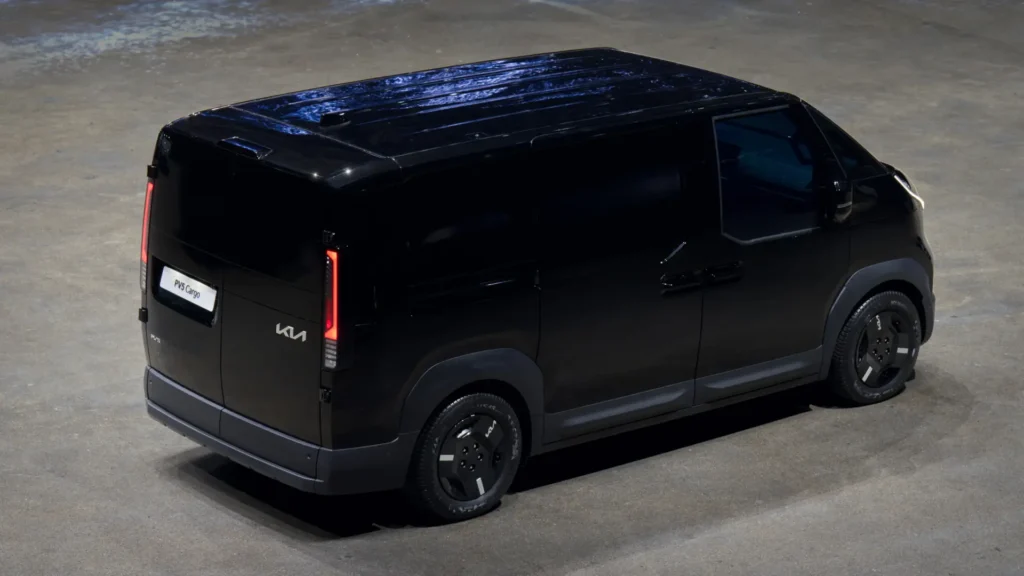
The PV5’s exterior design work was started in Kia’s European studios and completed in Korea, and follows Kia’s ‘Opposites United’ philosophy, balancing a futuristic aesthetic with robust practicality. The exterior features a clean, modern profile, integrated technical lighting, and durable cladding built to withstand heavy commercial use.
Karim Habib, Executive Vice President of Design at Kia, explained the design ethos: “We are designing primarily a vehicle for logistics, for delivery, but it’s a ground-up EV. We wanted it to be understood as a modern working tool. That’s why we believe it looks futuristic — it’s a work tool for a new era.” He also noted practical design choices, such as the segmented lower bumper: “The lower bumper is in three sections, so you don’t have to change the full bumper if there’s a scrape. You can just remove and replace the corners.”
Designed entirely in Korea, the interior features a new ‘AddGear’ system, which allows users to customise the van’s interior with modular accessories that can be easily added or removed post-purchase. Some mundane items — umbrella holders, coat hooks and the like — are expected to be joined by more adventurous accessories, including some powered by the vehicle. If done well, businesses could adapt their PV5 as their needs evolve.

Expanding the Kia PV5 lineup
Kia has confirmed that additional PV5 variants will follow, including a Crew model designed for combined cargo and passenger transport, and a Wheelchair Accessible Vehicle (WAV) model with a side-entry ramp capable of supporting up to 300kg.
Further conversion models, such as the Drop Side, Box Van, and Freezer Box, will roll out between 2025 and 2026, catering to logistics and food delivery industries. A Light Camper variant is also on the horizon, reinforcing the PV5’s potential for both business and leisure applications.
The PV5 will not be the only vehicle in Kia’s commercial EV lineup — a larger PV7 van is planned for the future, with a full-size PV9 likely to follow.
Kia PV5: Expected pricing and availability
The PV5 is set to hit the European markets in the second half of 2025, with other regions to follow in 2026. Full UK specifications and pricing will be confirmed later this year, with the van expected to make its British debut at the 2025 Commercial Vehicle Show.
With a target price of around €30,000 (approximately £24,800) before taxes, the entry-level PV5 Cargo (with the smallest 43.3kWh battery) could undercut rivals like the Ford E-Transit Custom by as much as £20,000. If Kia can deliver this level of affordability while maintaining competitive range, payload, and tech, the PV5 could reshape the eLCV market.
Kia’s seven-year or 100,000-mile warranty also reinforces its commitment to long-term durability, which could make the PV5 a compelling choice for cost-conscious operators.
With further variants, a larger PV7 on the way, and a growing focus on commercial EVs, Kia appears serious about making its mark in the van sector.

- Van tyre advisories double risk of dangerous defect at next MOT - 5 November 2026
- New 292-mile Renault Trafic E-Tech electric prices start from £38,000 - 5 November 2026
- French Renault Trafic E-Tech pricing offers clues ahead of UK launch - 3 November 2026