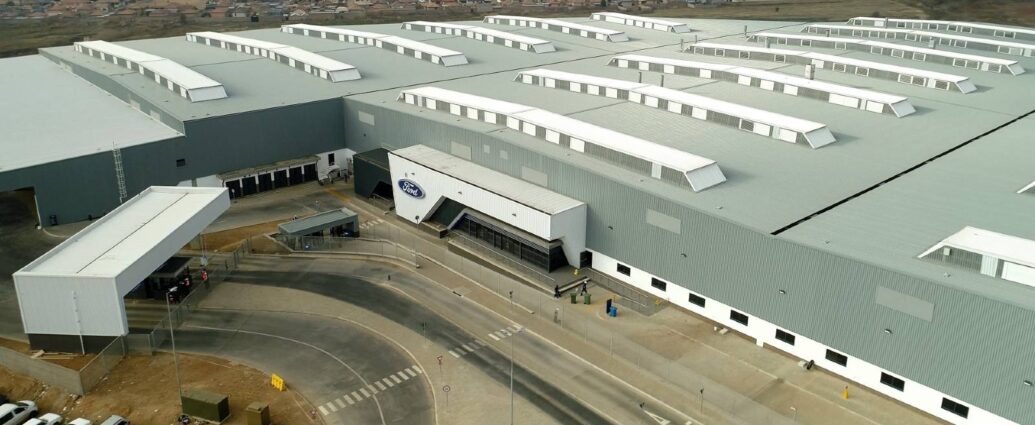
The final and largest piece of Ford’s R15.8-billion (£750m) investment in its South African operations has slotted into place with the new Frame Line starting operations ahead of production of the next-generation Ranger pickup later this year.
Located adjacent to Ford’s Silverton Assembly Plant, the Frame Line is the only Ford-owned and operated chassis manufacturing facility in the world. It measures a vast 100,000m2 and boasts the most advanced robotic manufacturing and quality control systems currently available.
“Our objective with the Next-Gen Ranger is to achieve the highest-ever production volumes and quality for the Silverton Assembly Plant, ensuring that the vehicles we deliver to our customers in South Africa and in more than 100 global export markets are world-class in every sense,” says Ockert Berry, VP Operations, Ford South Africa.
“The ladder-frame chassis of the Ranger pickup is fundamental to its overall quality, performance and durability, whether used as an everyday family vehicle or in hard-working commercial applications,” Berry says. “Accordingly, as with our new on-site Stamping Plant, bringing the manufacturing of the frame in-house allows us to carefully monitor and control every step of the production process.
“We invested in the latest robotic technologies for the welding and handling of the frame components, along with a fully automated e-coat system and robotic wax application,” Berry adds. “Rigorous quality checks are performed using advanced inspection and measurement systems, including the sophisticated three-dimensional blue light scanner system, to ensure that there are no compromises in quality.”

Two identical lines manufacture these large and heavy steel components, with 15 derivatives produced to support the various model iterations and the local and export market requirements. A total of 387 hourly employees and 25 salaried staff run the Frame Line in a two-shift operating pattern, all of whom have undergone extensive in-plant training.
“The facility is 95% automated, relying on 585 robots to assemble and weld the frames,” says Yetheen Gengan, Area Manager for the Ranger Frame Line. “We use the latest SKS automated intelligent welding system with I&K Pulse technology to guarantee the highest level of precision welding and consistency.
“Additionally, we have more than 1 000 tools on the lines, which includes buffers and robot grippers, resulting in a seamless production process that eliminates manual handling and operations that could introduce variances in manufacturing quality,” Gengan adds.
Alongside the production area is an e-coat facility where the frames are immersed in a range of cleaning and phosphate solutions before being submerged in an electrically charged tank where the paint is uniformly bonded to the metal. A robotic station then applies a protective wax inside the frame to provide rust protection and durability.
Rigorous quality control measures are implemented throughout the Ranger Frame Line, including in-line Perceptron measurement of every chassis produced in the plant. Furthermore, the high-tech GOM ATOS ScanBox blue light scanner system is used to create highly detailed 3D models of the entire chassis or individual sections, with the results compared to a stored design specification.

“With these advanced and extremely accurate measurement and scanning systems we are able to track real-time data to quickly identify and address any quality issues before the frame leaves the plant,” Gengan says. “All of the data is stored in our quality management system to monitor trends, and we can access the measurements and imaging data at any point should a concern be raised on any chassis we produced.”
As part of the extensive quality checks, the plant also incorporates a weld tear-down facility with world-class cutting and etching processes that assess the strength and integrity of individual welds.
Once the frames are completed, they are stored in an underground area with a capacity of 6,000 units. The frames are then processed through an automated sequencing facility and moved to the Silverton Assembly Plant, where the suspension and brake components, differentials, engine, gearbox, exhaust and fuel tank are fitted in sub-assembly areas. These then move to the Trim, Chassis, and Final line to be mated with the cab and load box.
“Having the Frame Line located right next door to the assembly plant is immensely advantageous, as it not only ensures that the frames are sequenced onto the assembly line in the most efficient manner, but it also eliminates the damage incurred when handling and transporting the parts by road,” Berry says. “All of this contributes to improved quality and greater customer satisfaction.”
- Farizon SV electric van to gain faster charging and four-wheel drive

- Geely Farizon admits European expansion will be ‘extremely challenging’

- Electric Van Man plugs market gap with UK’s first dedicated used electric van dealership
- Stellantis sets 2029 date for next-generation large van
- Ford puts Transit City to work with new chassis cab

- Farizon SV electric van to gain faster charging and four-wheel drive - 18 September 2026
- Geely Farizon admits European expansion will be ‘extremely challenging’ - 18 September 2026
- Electric Van Man plugs market gap with UK’s first dedicated used electric van dealership - 17 September 2026