
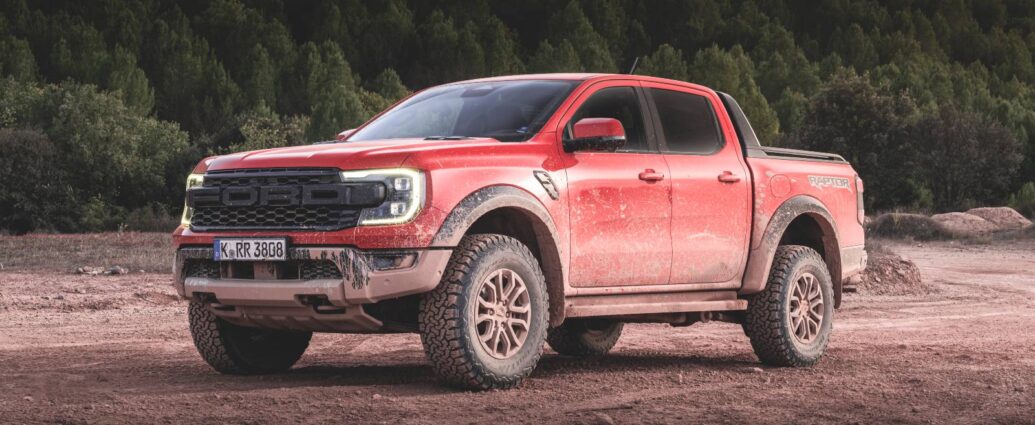
I won’t buy a Ranger Raptor until Ford puts a V6 under the bonnet. That’s a cry we’ve heard many times since the pickups’ introduction in 2018. Ford has fixed that for you, slotting a 3.0-litre V6 petrol engine in the front of the truck.
It’s also the first look at the next-generation Ranger, albeit in a rather more extreme form than the Wildtrak spec we like to buy in the UK.
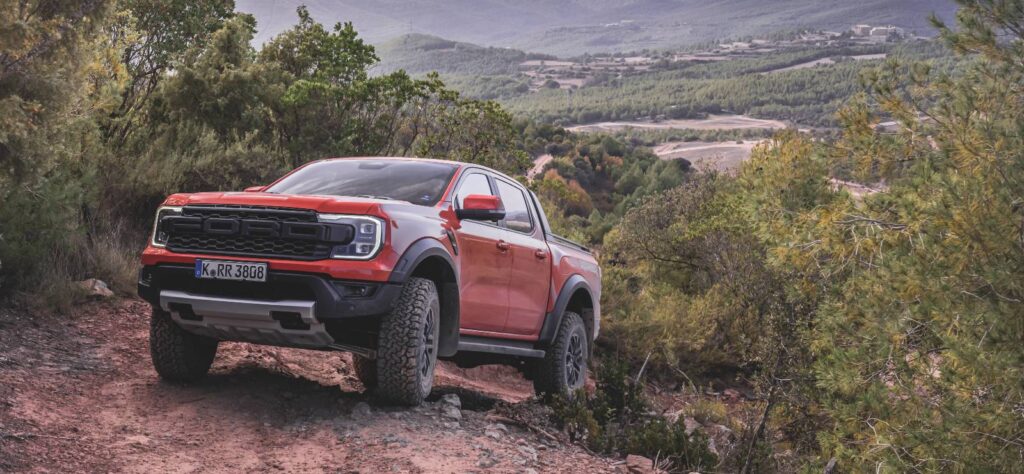
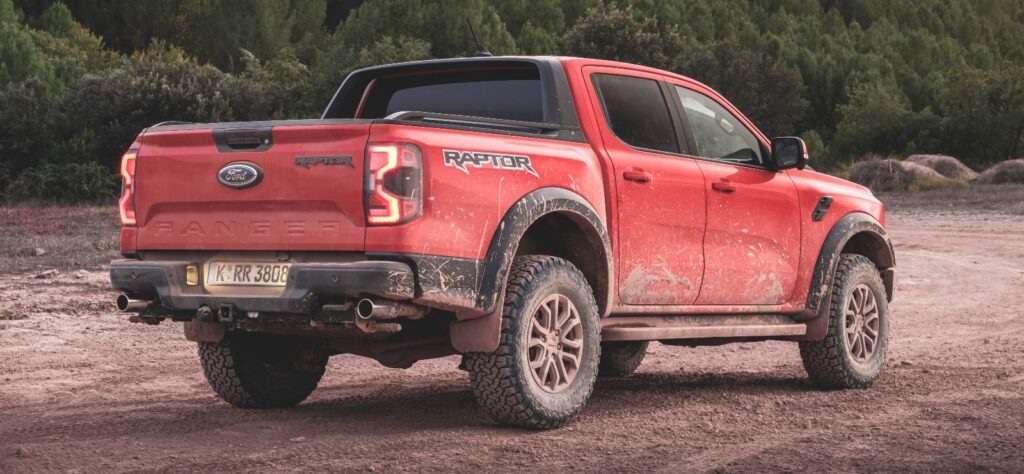
Similarities between your everyday Ranger and the high-performance Raptor remain, so you’ll find the C-clamp LED daytime running lights, but these surround a bold black grille with FORD writ large across it. Flared wheel arches, larger bumpers separated from the grille, a pair of built-in tow hooks, a 2.3mm thick steel bash plate, functional vents, dark alloy wheels and 33-inch General Grabber all-terrain tyres all add to the first impression that the Raptor isn’t a truck to be trifled with. Finished in Raptor-exclusive Code Orange paint and with an enlarged power bulge on the bonnet to remind you of the V6 power beneath, it also demands attention wherever you are.
More power, bolder styling and the latest Ford Ranger cabin should all combine to make this the most desirable pickup we’ve seen. Phil Huff finds out…
Ford Ranger Raptor V6: Cabin
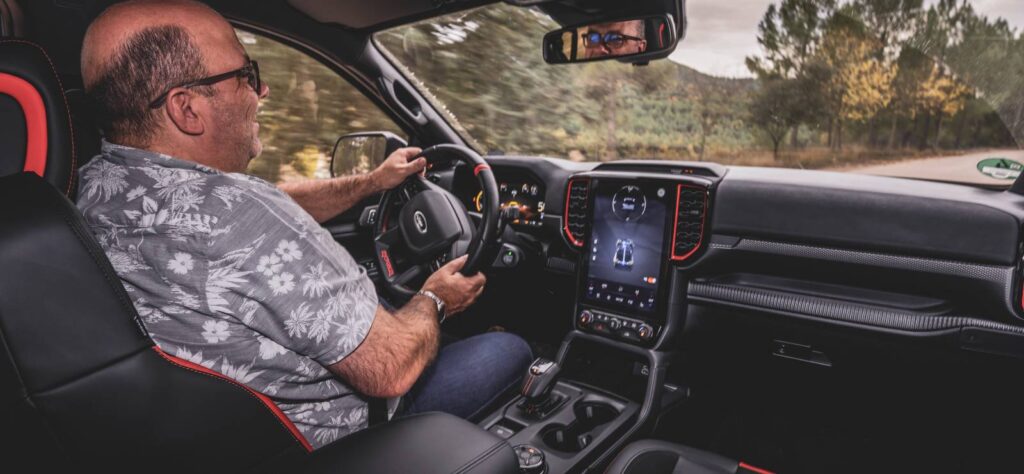
Previewing the next-generation Ranger, the Raptor V6 is packed with tech and a smattering of luxury. Most notable is the 12.0-inch infotainment centre stuck vertically in the centre stack. Pleasingly, some physical controls remain, so you’ll be able to adjust the climate control and stereo volume — sound comes via a 10-speaker Bang & Olufsen system — but everything else is accessed via the screen.
It used Ford’s latest Sync 4A software which is crisp, clear and reacts quickly. It’s not always the easiest to use, with some settings in unintuitive areas, but, as with most of these systems, once you’ve got it set how you want it, you’ll rarely touch it again.

A 12.4-inch digital instrument panel sits in front of the driver. This is customisable to a degree, but changes in response to the seven driving modes, always offering what it hopes is the most relevant information.
Steering wheel shortcut buttons allow quick changes to be made to the steering (three settings), suspension (three settings), and exhaust note (four settings). Turn everything down, and it’s unexpectedly refined, with little noise from the engine or exhaust and just a bit of wind noise ruffling its way through to the cabin. Go the other way, and the passenger compartment is filled with the barking exhaust note rumbling away. It’s loud but not intrusive, although it sounds better from the outside.
Space is plentiful, with loads of elbow room and lots of headroom, even in the back. While apparently inspired by those in an F22 Raptor fighter jet, the seats are a little disappointing, lacking lateral support, especially around the shoulders. The leather-faced seats look and feel good, but some cloth or suede would hold you in place more effectively.
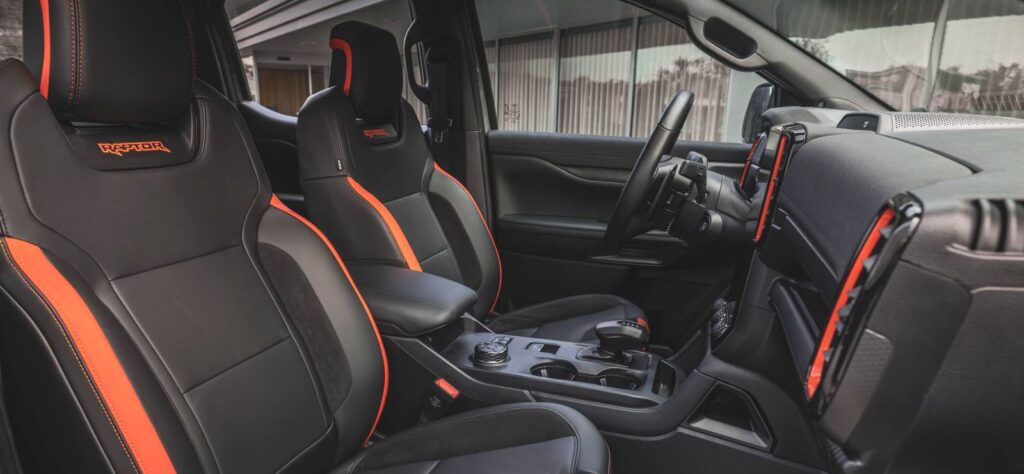
The cabin is the finest we’ve yet seen in a Ford pickup, with pleasant-feeling plastics and some fine design touches, although there’s a surprising lack of space for essential work gear, like laptops. Some Alcantara-like material covers some of the dashboard surfaces, and there are Code Orange highlights dotted around, along with Raptor logos dotted around. Even the steering wheel gets one and a position marker at the top centre.
There’s seemingly every option included, so you’ll have wireless Android Auto and Apple CarPlay, dual-zone climate control, USB-A and USB-C sockets, built-in navigation and plenty more.
Ford Ranger Raptor V6: On the Road
The new 3.0-litre V6 petrol engine in the Raptor provides 292hp and 491Nm of torque, all going through the usual 10-speed automatic gearbox. For the first time, there’s permanent all-wheel drive, with power split between wheels as the onboard computers see fit. There will be a 2.0-litre diesel option, but that’s not arriving until well into 2023.
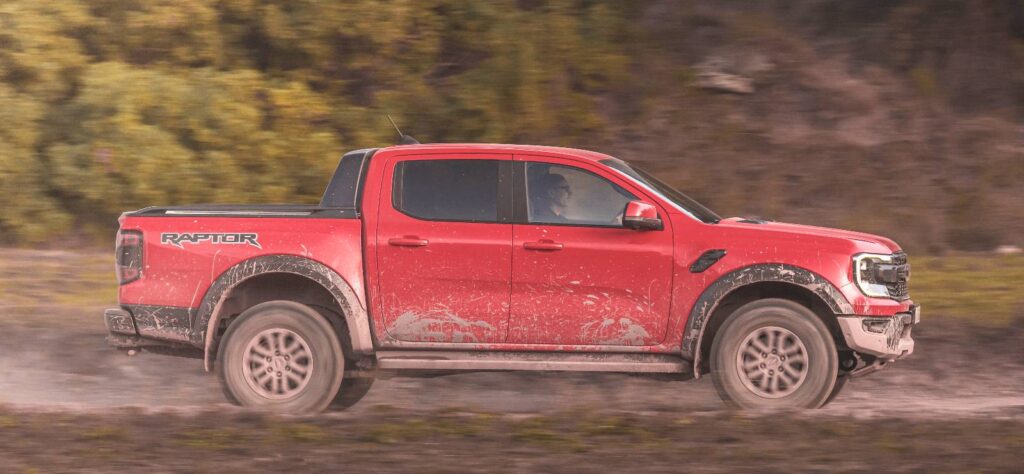
With the larger engine, performance is potent — at least for a 2.5-tonne pickup. It’ll get from a standstill to 62mph in 7.9 seconds and go on to 111mph if you’re brave enough. Put your foot down, and the Raptor shifts through all 10 gears smoothly, while there are also some manual shutters behind the steering wheel if you want to take control. It’s not perfect, though, as, in automatic mode, the gearbox can spend a fair bit of time hunting around and deciding what the right gear might be. More frustratingly, if you take manual control momentarily, the computer kicks in and switches it back to automatic mode within a few seconds.
Still, get past that, and on-road performance is impressive. It’s not quite physics-defying, but there’s more urge than you have any right to expect from a pickup truck.
Performance of that level might leave you thinking it’ll be stiffly sprung, but Ford Performance has tuned the Raptor near-perfectly for on-road driving. It’s soft and comfortable, gliding over nearly all imperfections in the road, while body roll is well controlled, so it never feels unwieldy.
There’s not much feel through the steering wheel, but that’s largely going to be thanks to the huge General Grabber all-terrain tyres. These are the limiting factor on the tarmac, losing grip earlier than you would want. When it does break loose, it’s slow, controlled and soon brought back in line.
So what makes it so good? Countless changes under the bodywork have turned the Raptor into something rather special. It starts with the chassis, which has been strengthened and stiffened over the regular model, alongside revised mounts and reinforcements for the C-pillar, load box and spare wheel. New frames for the shock towers and brackets ensure it can take the hits on and off-road.
The suspension changes work the most magic, though, and that’s been completely rebuilt for the Raptor. New upper and lower control arms, extended travel suspension and independent rear suspension, give the base, with Fox 2.5-inch Live Valve shock absorbers keeping it all under control.
They work overtime off-road, where we spent much of our time with the next-generation Ranger Raptor. Heading into uncharted territory — ok, reasonably charted territory with some spotters walking with us — the Raptor was literally unstoppable. This wasn’t some tame off-road course either, but demanding terrain that needed some skill to traverse, as evidenced by a handful that got their techniques wrong and came unstuck.

Use the features of the Raptor to their maximum, and you’ll go far. There’s a two-speed transfer case with locking differentials front and rear, controlled by seven driving modes; four dedicated to off-road driving, two for use on the road, and one final mode, Baja, for going a little bit crazy.
The reality is that, with some gentle throttle controls, you don’t really need that many choices. Being delicate in this brute is easy as the engine is smooth and controllable. Creeping along is a piece of cake, with no jerking as the drive kicks in. Cameras around the pickup help spot obstacles, but while the picture is incredibly clear, it’s relatively small, even on that 12-inch screen.
The screen — and the 12.4-inch instrument panel in front of the driver — can be set to show all sorts of information about what’s going on, including angles all around. The truck felt stable with a side angle of 26°, even with one wheel kicked in the air. Axle articulation is impressive, with the twin locking differential ensuring you can make progress even when there’s less than the optimal number of wheels in contact with the ground. The long wheelbase (3,270mm) counts against it a little, but ground clearance of 265mm helps clear most obstacles.
| Approach angle | 32° | Climbing angle limit | |
| Departure angle | 24° | Ground clearance | 265 mm |
| Ramp angle limit | 24° | Wading depth | 850 mm |
It’s as impressive as anything this side of one of Arctic Trucks’ conversions. The fact it combines superb off-road prowess with remarkable on-road performance is satisfying, but there’s one more party trick.
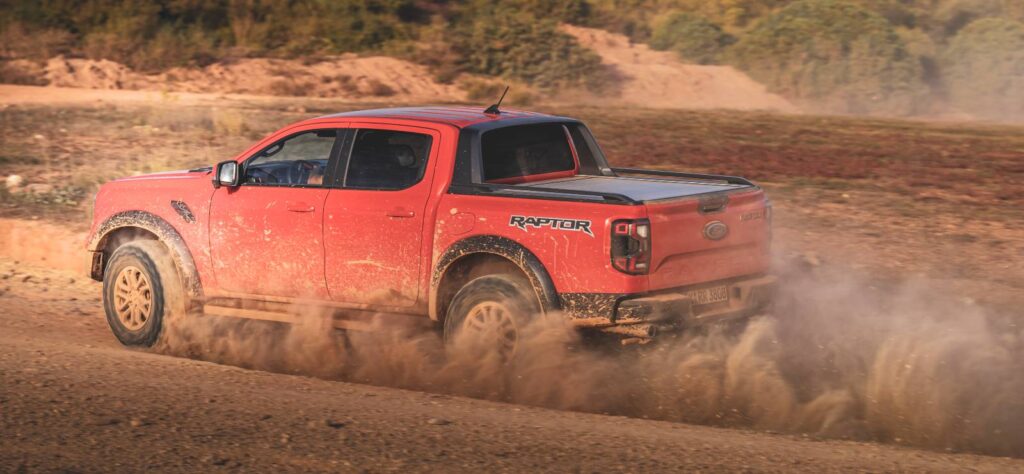
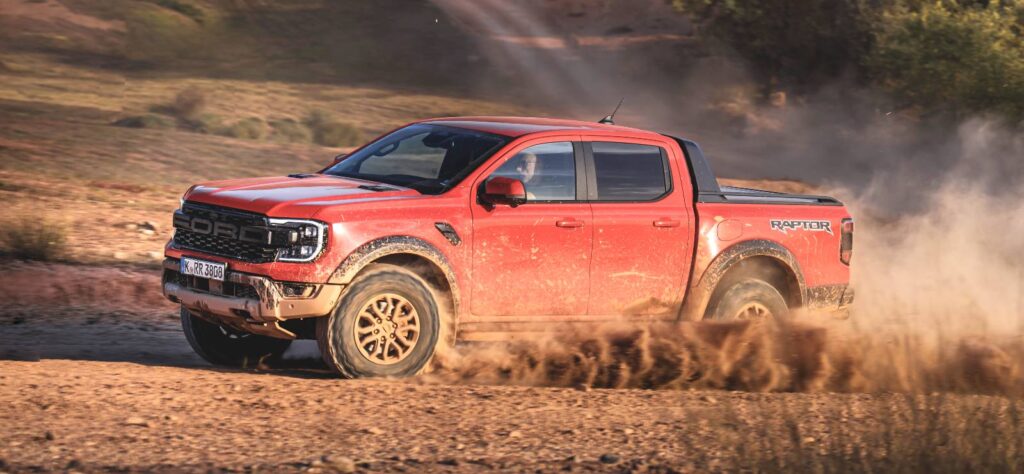
Baja mode. Hit this button, and the character of the truck changes. The exhausts open, releasing a blunt V6 roar from the twin exhaust pipes, engine responses are sharpened, the steering is tightened, and even settings for the ABS brakes, traction control, and stability control are set to extreme ends of the spectrum.
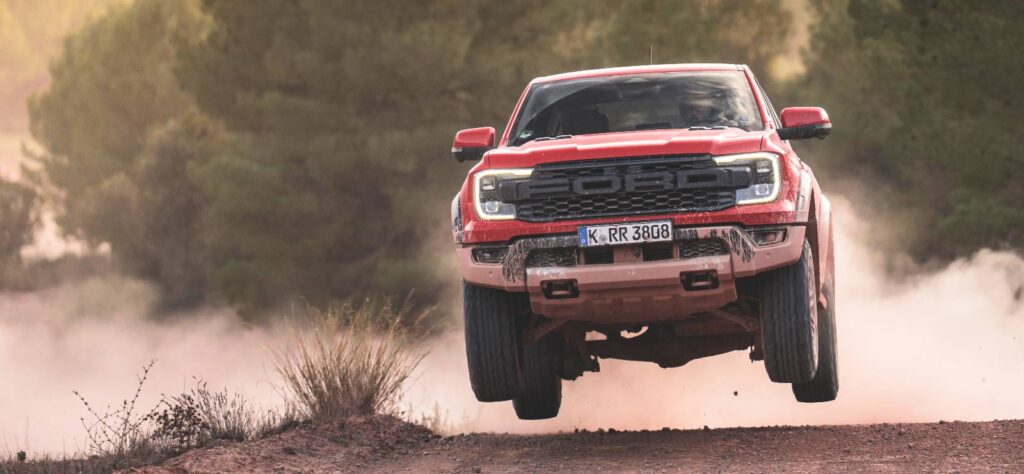
For what purpose? Fun. Find a suitable area — and, conveniently, one was available — and you’ll be able to cover dirt tracks at speeds that would get the attention of the police if you were on the road! Drifting sideways, leaving clouds of dust in your wake, is a cinch, although it takes a little effort to get the front end to tuck in. Brake action is unnervingly strong (which isn’t always the case on the road), and the suspension takes anything you throw at it. Even throwing it through the air doesn’t faze it, as the Fox suspension adapts mid-flight to prepare for the landing.
Ford Ranger Raptor V6: Economy and Running Costs
The Raptor laughs in the face of rising fuel prices. While the world is looking at improving fuel efficiency or switching to electric power, the 3.0-litre V6 engine in this pickup manages a paltry 20.4mpg. And that’s the official figure. Relatively gentle driving on public roads resulted in a figure of just 15.4mpg, while it dropped to single digits when crushing the off-road route we were following.
As with the outgoing Raptor, the payload limits aren’t high, so the pickup doesn’t qualify as a commercial vehicle. You’ll not be able to reclaim the VAT element for your business, where it’ll be treated as a passenger car and taxed accordingly. For a taxpayer on the 40% rate, expect a monthly company car tax bill in excess of £700.

Other costs are likely to be reasonably high too — you’re unlikely to get any change from £250 if you need a new tyre, for example.
And, of course, it’s going to be a personal money pit. We all know it. It starts with a light bar, then perhaps some larger wheels, then a canopy, maybe a winch, and so on!
Ford Ranger Raptor V6: Payload and Towing
Despite all of the changes to the Raptor, the load bed remains the same size as on the regular Ranger double cab models, so it’s 1,564mm long and 1,224mm wide.
For commercial users, that’s where the good news ends. The strengthening of the chassis, upgraded suspension, large tyres, and that 3.0-litre engine all need to be supported when careering across fields, through forests and along ravines, and all at speed. Ford’s engineers have worked wonders to bring it all together, ensuring it can cope with any terrain, but that comes at a price: payload.
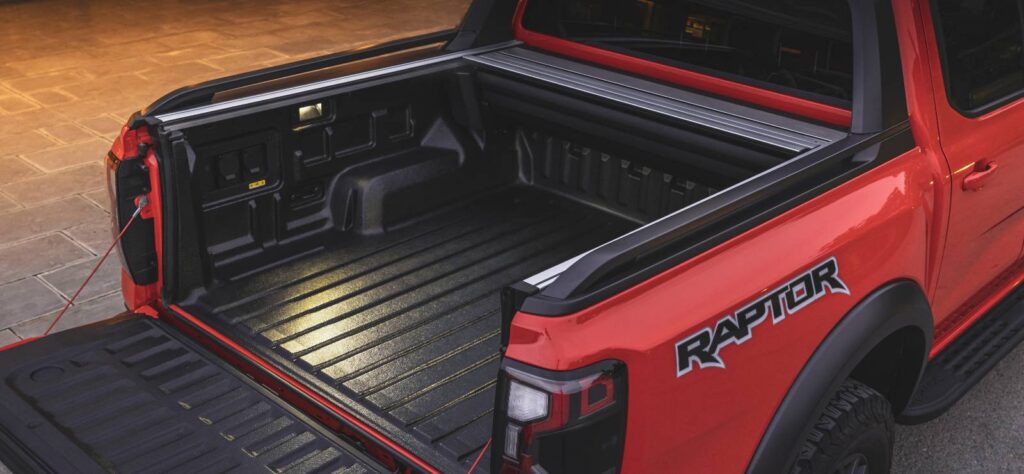
At 652kg, the maximum payload falls well short of the standards we expect for a pickup truck. Likewise, its towing limit of 2,500kg will be lower than many readers will need. There’s also a gross train weight rating of 5,370kg to deal with, which means you’ve got to choose between a fully-loaded trailer or a fully-loaded pickup, but not both.
Ford’s Pro Power system is fitted to the load bed. This provides a three-pin power socket at the rear of the bed, allowing users to recharge a drill, plug in a sander, or power any number of tools. The tailgate even includes sections to attach a clamp so that, for example, pieces of 2×4 can be kept in place when being cut to size.
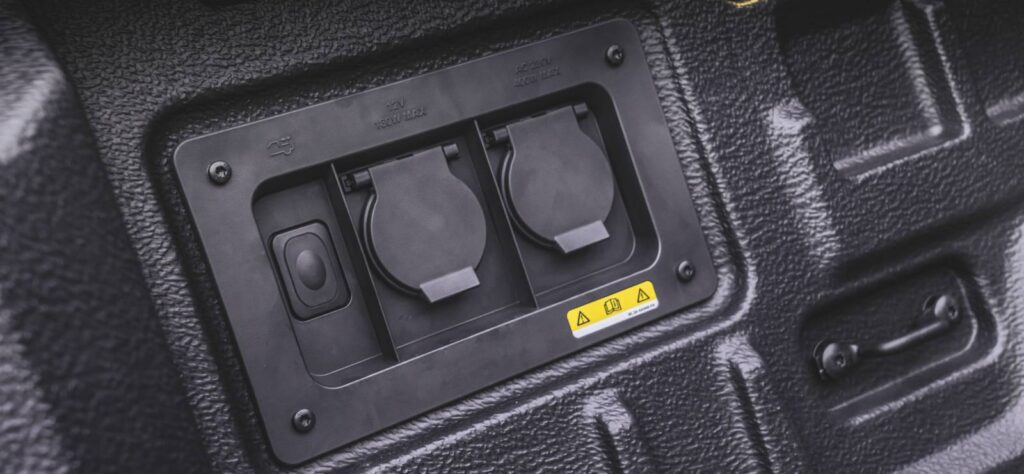
For the Raptor, that power is likely to be used for lights, a sound system and maybe a grill. One potential customer suggested that it would be handy to recharge electric mountain bikes, ready to ascend a climb before hurtling back down again.
As well as external power sockets, the Raptor comes pre-wired for upfitters. A bank of six switches mounted on the cabin’s overhead panel provides auxiliary power to accessories from light bars to air compressors — two at the front, two at the back, and two on the roof.
For commercial users, the limitations could be a deal breaker. For those that won’t be making such demands on their vehicle, there are a lot of positives.
| Kerb weight | 2,454 kg | Load bay length | 1,564 mm |
| Gross vehicle weight (MAM) | 5,370 kg | Load bay width | 1,224 mm |
| Payload | 652 kg | Load bay height | 529 mm |
| Gross vehicle mass | 3,130 kg | Liftover height | 877 mm |
| Towing capacity (unbraked) | 750 kg | Towing capacity (unbraked) | 2,500 kg |
Ford Ranger Raptor V6: Verdict
Commercial users looking for a go-anywhere truck that can cope with heavy loads and hard towing will need to look elsewhere. For everybody else who wants a performance pickup, there’s literally nothing else quite like the Raptor.
The addition of the petrol V6 engine is responsible for much of the transformation, but it does come at a cost — an optimistic 20mpg is tone-deaf for the times. If you can accept that, the performance is prodigious, the drive is delightful, and its off-road ability is outstanding.
It’s a niche product and one that Ford doesn’t expect to be a best seller. For those that feel it’ll fit their needs, you’ll have more fun than anybody else on the road. Or off it.
Model tested: Ford Ranger Raptor 3.0L EcoBoost V6
| Basic price | £48,300 | On the road inc VAT | £57,960 |
| VAT | £9,660* | Model range exc VAT | £39,350†-£48,300 |

- Stellantis sets 2029 date for next-generation large van - 17 September 2026
- Ford puts Transit City to work with new chassis cab - 16 September 2026
- Kia PV7 reveal: Everything we know about Kia’s new electric van - 14 September 2026