
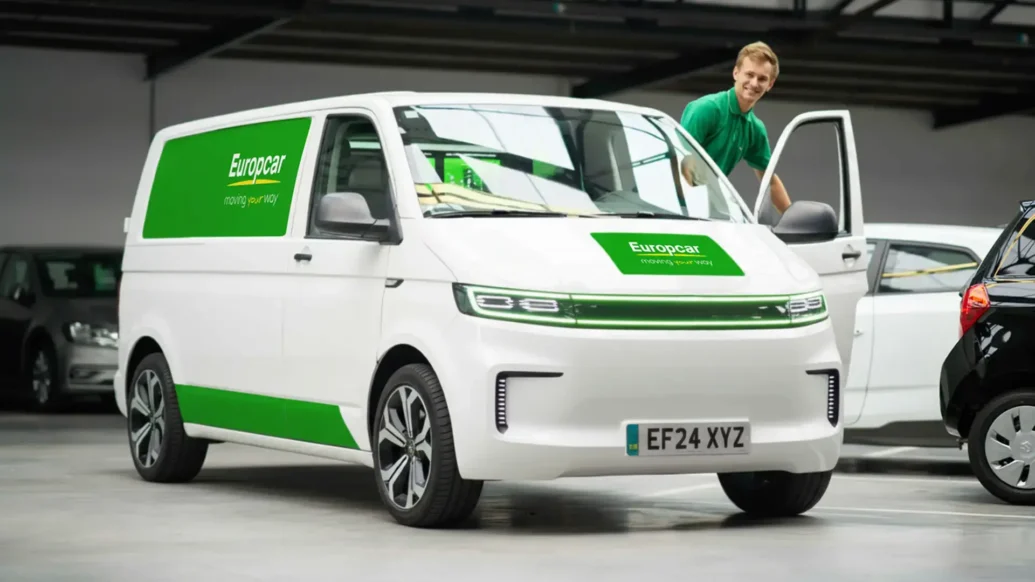
Five million vans now account for 16% of UK road emissions — but despite more electric models than ever, small firms are still struggling to plug in.
That’s the backdrop to a new sustainability report from Europcar, which argues that short-term rental could play a vital role in helping small and medium-sized businesses get comfortable with electric vans.
According to SMMT data, just 22,155 new battery-electric vans were registered in 2024, holding a market share of 6.3% for a second year running. That’s despite more than 30 different models now being on sale. Most orders so far have come from large fleets, such as Royal Mail, BT, and Amazon, leaving smaller firms behind.
Awareness of support schemes is patchy, too. The Plug-in Van Grant can reduce purchase costs by up to £5,000, but many SMEs still aren’t taking advantage of it. Europcar’s own research shows that 52% of van drivers want to switch to electric vehicles, especially as 72% of drivers are already affected by Clean Air Zones, but high upfront prices, range concerns, and uncertainty about charging are holding them back.
While Zapmap, the UK’s largest charge point map provider, reports a 37% growth in charge points last year, van drivers face practical headaches. Many bays are still too tight for a Transit, and depot upgrades can drag on for years while operators wait for grid connections. The BVRLA has warned that without targeted investment in commercial vehicle charging, uptake could stall further.
Fleet managers remain bullish, though. UK operators expect 40% of their fleets to be electric within three years — double the expectation of their European counterparts.
Europcar’s central pitch is that rental can help bridge the gap. It allows firms to test vans in real-world conditions without long-term risk, whether that’s a day on deliveries or several months of trial use. To ease concerns around charging, the company requires only a 20% state of charge on return, with vehicles leaving the depot at 80%. And Europcar has introduced price parity between electric and diesel rental rates for business customers — a move aimed at removing cost as an excuse not to try.
“Trying out an e-van is by far the best way to understand the technology and the use cases,” said Paul Kirby, Commercial Director at The EV Cafe, in his foreword to the report. “Rental provides a fantastic ‘no risk’ opportunity, taking a vehicle for a limited period to learn from the experience.”
Europcar says 14% of its fleet is now electric or plug-in hybrid, with utilisation of its EV stock more than doubling in 2024. The business also claims CO₂ savings equivalent to 168 tonnes last year from measures ranging from e-bike deliveries to carbon-balanced paper use.
Looking ahead, the company wants to expand its electric van range, which currently includes models such as the Mercedes eVito, Renault Kangoo E-Tech and Vauxhall Combo Electric. Whether SMEs take advantage of that flexibility, or continue to wait on the sidelines, could determine how quickly the UK van parc starts to decarbonise.

- BYD Shark first drive review: A different kind of working pickup - 22 October 2026
- Kia PV7 order books to open in April 2027 as 23-variant range takes shape - 19 October 2026
- Tool theft leaves nine in ten tradespeople unable to work - 19 October 2026