
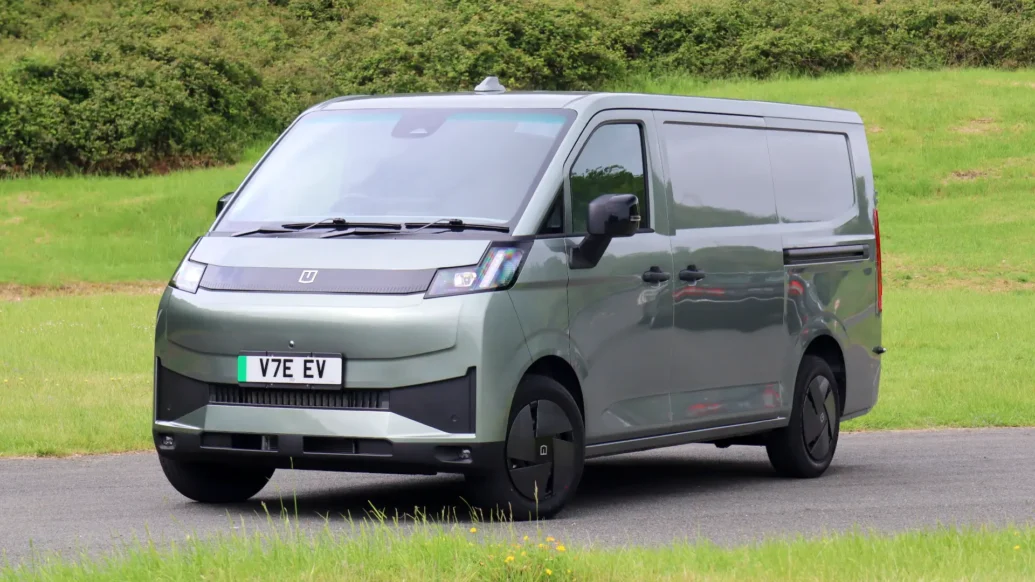
Farizon may still be an unfamiliar badge to most UK van operators, but it’s not a name to ignore. Backed by Geely — the group behind Volvo, Polestar, Lotus and LEVC — the Chinese commercial vehicle brand has already launched the larger SV in the UK, and is now following it with the smaller V7E.
This is a compact electric van aimed at urban and regional work, and Farizon has kept the UK range deliberately simple. There is one body size, the L1H1 panel van, and two battery options: 50kWh or 67kWh.
It also arrives at an interesting time. Chinese van makers are beginning to circle the UK market, with Chery preparing its Delivan, Foton entering the sector, and even Ford readying the China-designed Transit City. Farizon is not alone, then, but the V7E gives it a credible second product in a market that is only going to get more crowded.

What is the Farizon V7E?
The V7E sits below the Farizon SV and takes a more compact, city-friendly approach. At 4,995mm long, 1,820mm wide and 1,985mm high, it is not a large van by modern standards, but Farizon claims a useful 6.95m³ of load volume. That puts it into surprisingly serious territory, with cargo space in the same broad ballpark as a Ford Transit Custom.
The version driven here was the 67kWh model, which has a quoted combined electric range of up to 204 miles, rising to 295 miles on the more forgiving city cycle. There’s an 11kW AC onboard charger, while DC rapid charging is rated at up to 100kW. According to Farizon, that means the larger-battery van can charge from 20-80% in 30 minutes, while a full AC charge takes 6.5 hours.
Power comes from a 110kW (150hp) electric motor, with 230Nm of torque. Those aren’t headline-grabbing numbers, but they’re more than enough for a van of this size and purpose.
What’s it like to drive?
Better than expected in some ways, rougher than expected in others.
Performance isn’t an issue. The V7E pulls away cleanly, accelerates quietly and has enough punch to feel comfortable in faster traffic. It will also push well beyond UK motorway speeds if given the opportunity, so there’s no sense that Farizon has built something that only works at city speeds.
The handling is also better than the tall, narrow-looking body suggests. The steering is light and not especially communicative, but the V7E changes direction neatly enough and feels more settled than expected. In tighter sections, its relatively compact footprint helps, and visibility from the cab is good.
Ride quality is where the V7E struggles. Empty vans are rarely at their best, but this one felt particularly unsettled at lower speeds, with a harsh rear-end response over sharper bumps. It improved noticeably as speeds rose, where the van felt more composed, but anyone expecting electric propulsion to automatically bring car-like comfort will need to lower their expectations.
There is an important caveat. We didn’t get the opportunity to put any weight in the back. A decent load may well calm the suspension down, and many working vans will spend plenty of time carrying something. But until we drive it properly loaded on public roads, the ride remains the biggest unanswered question.
What’s the van like inside?
This is where the V7E starts to make a stronger case for itself. The cabin feels more convincing than the larger Farizon SV’s, with a layout that is easier to understand and more pleasant to use. It is not plush, but nor does it feel cheap or thrown together.
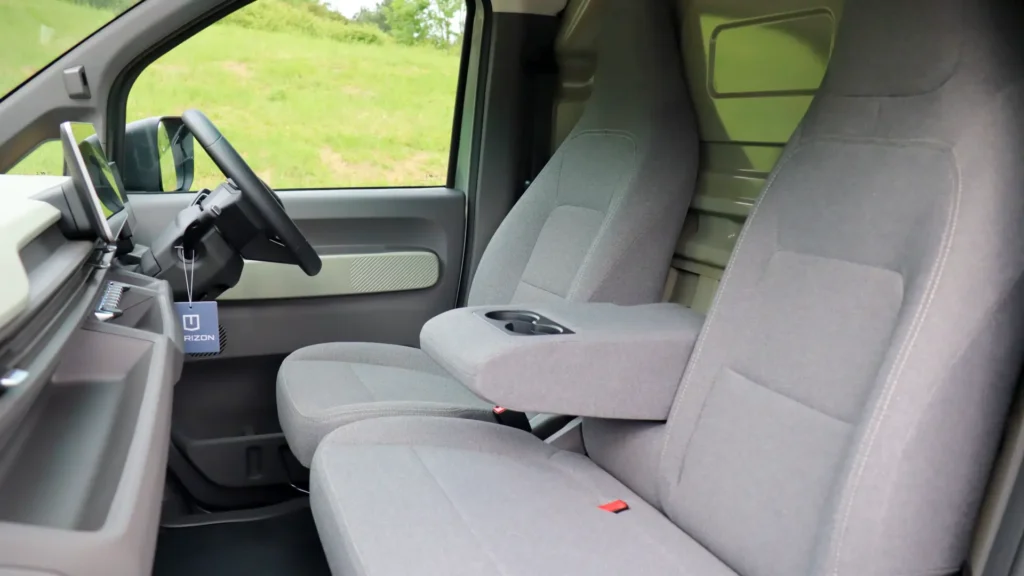
The driving position works well for an average-height driver, the seat is comfortable, and the wide centre armrest gives the cab an unexpectedly relaxed feel. That armrest is unusually large because the V7E is a two-seater, something that will immediately rule it out for some operators.
But there is an upside. Farizon hasn’t tried to squeeze in a compromised middle seat just so it can claim three-abreast capacity. Instead, the centre section has proper cupholders and a broad resting point for the driver’s left arm, making the cab feel more spacious and useful for one or two people.
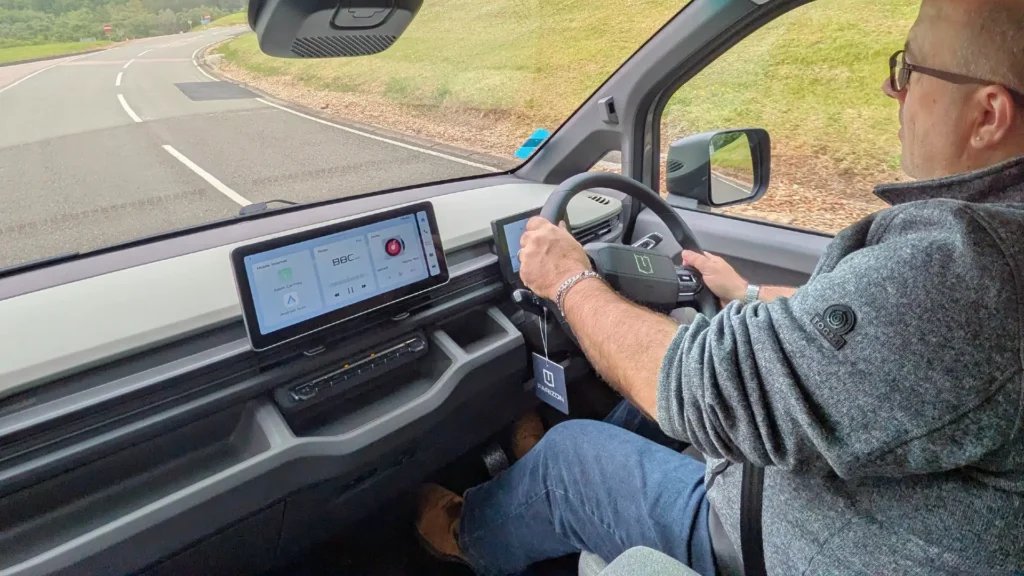
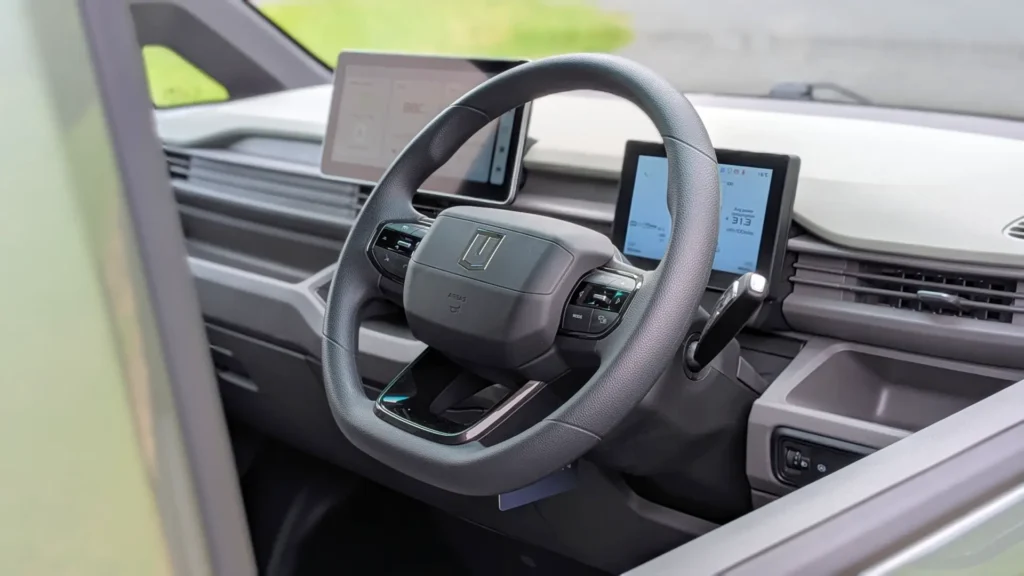
Standard equipment is generous. The V7E gets a 12.3-inch touchscreen, a 7.0-inch digital instrument cluster, Apple CarPlay, Android Auto, Bluetooth, two USB ports, a 12V outlet, vehicle-to-load capability, and even a ventilated (but not heated) driver’s seat.
The safety and driver assistance kit is similarly comprehensive, with front and rear parking sensors, automatic LED headlights, rain-sensing wipers, a 360-degree camera, blind-spot detection, rear cross-traffic alert, lane-keep assist, autonomous emergency braking, traffic sign recognition, and intelligent cruise control.
The infotainment system is less impressive. Some functions are buried too deep in menus, and it rarely feels as intuitive as it should be. Physical controls for some key functions help, but Farizon still has work to do here.
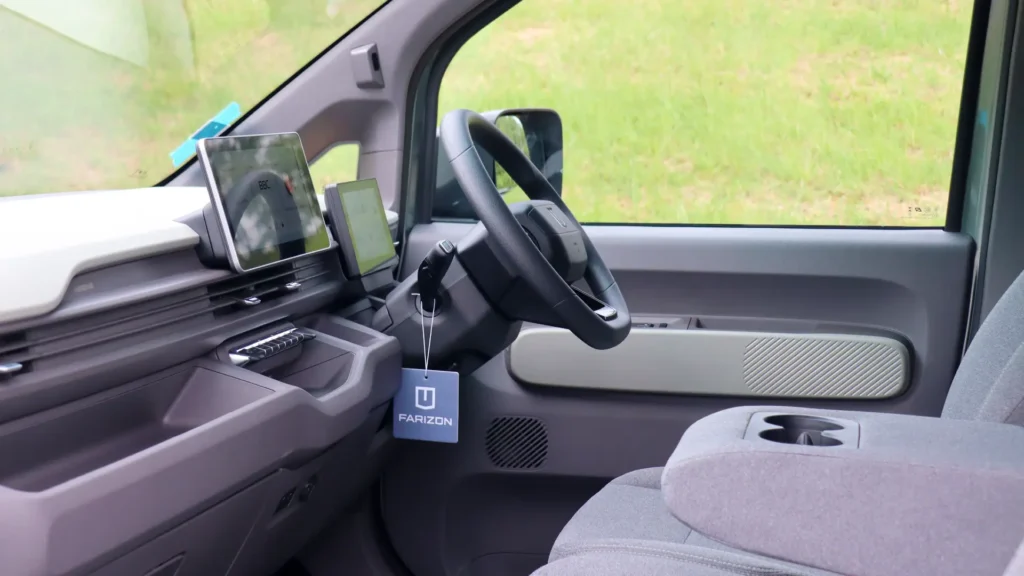
It is also worth noting that the V7E gets basic air-conditioning rather than proper climate control, which feels a little mean in an otherwise well-equipped electric van.
How practical is the Farizon V7E?
On paper, very practical indeed.
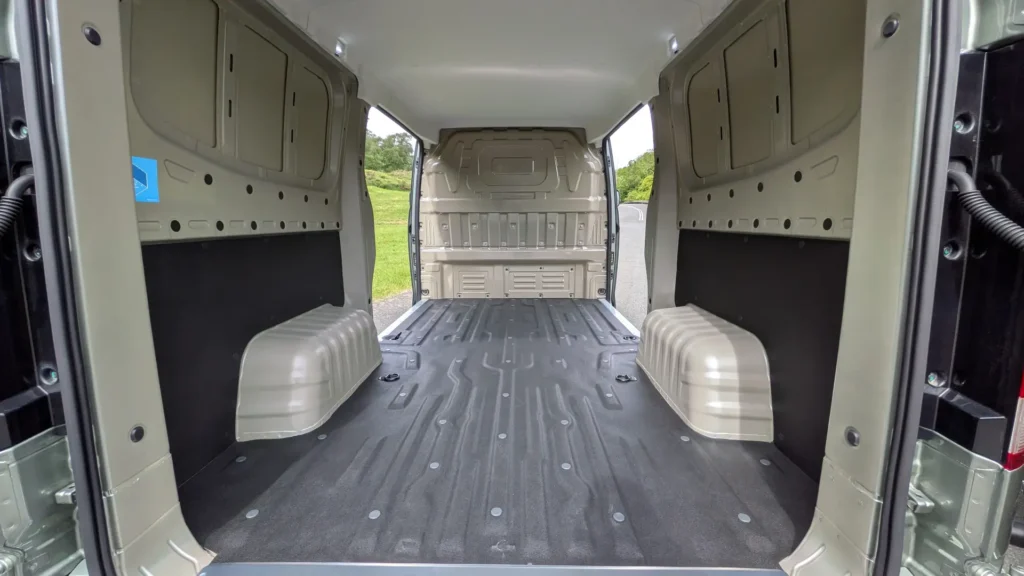
The V7E offers 6.95m³ of load volume, a cargo length of 2,730mm with the bulkhead in place, and 1,250mm between the wheelarches, which is enough for a Euro pallet. The cargo platform height is listed at 510mm, while the maximum payload for the 67kWh model is 1,208kg.

Our van had the standard load area, with a plastic-covered floor, a solid metal bulkhead and tie-down points throughout, but no ply lining. The low step-in height should make loading easier in daily use, especially for operators making repeated drops.
Twin sliding side doors are standard, and that’s a major plus. For urban deliveries, kerbside work or operators regularly loading in awkward spaces, access from both sides of the van is genuinely useful rather than just a brochure-friendly feature.
The rear doors are less convincing. They open to around 270 degrees and are held in place by magnets when fully folded back, which is useful. But they don’t stay open at 90 degrees, instead swinging freely. That might sound like a small detail, but it’s the sort of thing working drivers notice after the novelty of a new van has worn off.
Farizon V7E: The early verdict
The Farizon V7E isn’t a polished class leader, but at £28,000 plus VAT, it’s a credible electric van — and probably Farizon’s most convincing UK model so far.
It looks distinctive, has useful load space, strong payload potential, twin sliding side doors and more than enough performance for UK roads. The cabin is also a step forward from the larger SV, with a smarter layout and a two-seat arrangement that makes the front of the van feel genuinely spacious.
There are issues. The low-speed ride is poor, the infotainment system is awkward, and the rear doors not staying open at 90 degrees is the kind of detail that could become irritating very quickly. The two-seat layout will also make it a non-starter for some fleets.
But as a first impression, the V7E does enough to be taken seriously. It needs a proper loaded test on public roads before we can deliver a full verdict, but Farizon has moved beyond simply being an interesting new name. With the V7E, it now has a compact electric van that some UK operators may genuinely want to consider.

- KGM gains new Stamford outlet as TC Harrison joins network - 27 August 2026
- Iveco eSuperJolly First Drive: Familiar van, different proposition - 13 August 2026
- Mercedes Vito Sport-X brings sporty makeover to Crew van range - 12 August 2026